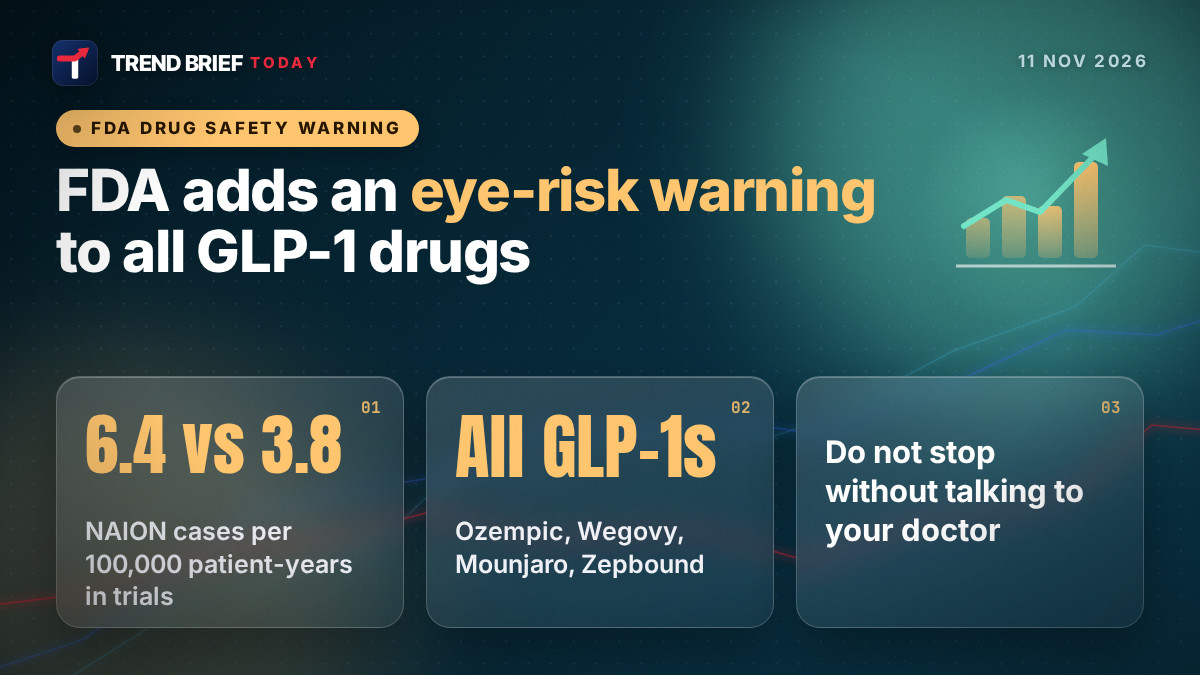
The US Food and Drug Administration (FDA) said on Monday 9 November 2026 that every GLP-1 drug, including Ozempic, Wegovy, Mounjaro and Zepbound, must carry a new warning about a rare eye condition called NAION, which can cause sudden and sometimes permanent vision loss in one eye. The FDA calls it a "potential increased risk" and says a cause-and-effect link has not been proven. In its pooled trial data the condition showed up in 6.4 GLP-1 users per 100,000 patient-years, against 3.8 for people on a placebo or another drug.[1][2][4]
 | |
| Announced | Monday 9 November 2026 (FDA Drug Safety Communication) |
|---|---|
| Condition | Non-arteritic anterior ischemic optic neuropathy (NAION), sometimes called an "eye stroke" |
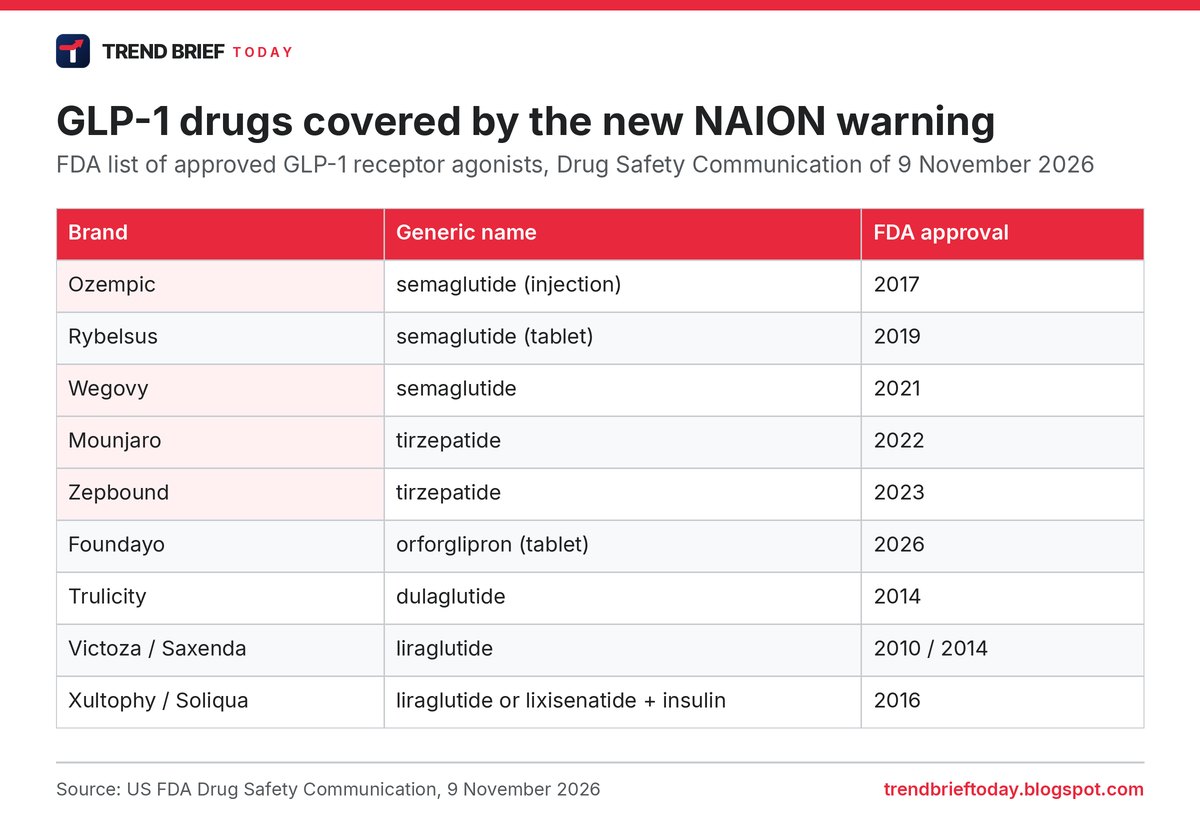
| Drugs covered | All FDA-approved GLP-1 receptor agonists, including Ozempic, Rybelsus, Wegovy, Mounjaro, Zepbound and Foundayo |
| Where on the label | Warnings and Precautions section |
| Trial rate | 6.4 vs 3.8 cases per 100,000 patient-years |
| Causal link | Not established (FDA, Novo Nordisk) |
| UK and EU | "Very rare" side effect of semaglutide since 2025 (EMA) and February 2026 (MHRA) |
What the FDA ordered
The agency published a Drug Safety Communication on 9 November. It tells the companies that hold approvals for GLP-1 receptor agonists to add information about NAION to the Warnings and Precautions section of their labels. That is the part of a US label doctors read for serious risks they should know about before prescribing.[1][4][13]
The wording matters. The FDA did not say these drugs cause NAION. It said it found "a potential increased risk of rare NAION events in patients taking GLP-1 RAs" after looking at clinical trials, animal studies, adverse event reports and outside research. It also noted that NAION cases have been reported with every GLP-1 product now on the US market, which is why the warning covers the whole class and not one brand.[1][2][5]
The list in the FDA notice runs from older diabetes injections such as Victoza and Trulicity to the newest weight-loss drugs. It includes Foundayo (orforglipron), Eli Lilly's GLP-1 pill approved this year.[1][2]
What NAION is
NAION happens when blood flow to the front of the optic nerve, the cable that carries signals from the eye to the brain, drops for a while. The nerve is starved of oxygen and part of it is damaged. The FDA describes the result as "acute, painless, decreased vision in one eye, including permanent vision loss". Doctors still do not fully understand what triggers it.[1][3]
STAT notes it is sometimes called an "eye stroke", and that there is no proven treatment to bring the lost vision back. The American Academy of Ophthalmology told the BBC there is no known treatment to reverse it and that it is the most common cause of sudden optic nerve injury in people over 50.[4][3]
Known risk factors, according to the FDA, include smoking, diabetes, high blood pressure, sleep apnea, anemia and kidney disease. Many people prescribed GLP-1 drugs already have one or more of these, which is a big reason the evidence has been hard to read. Someone who has had NAION in one eye is also at higher risk of it in the other.[1][5]
Symptoms to know
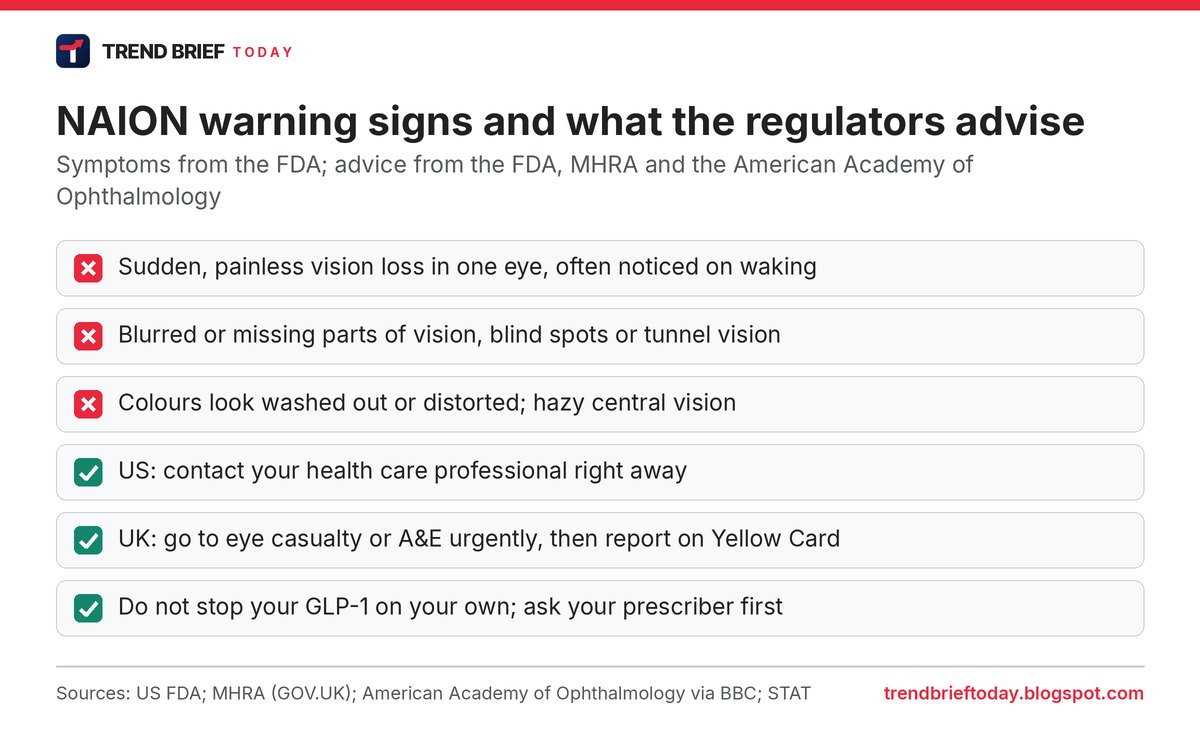
The FDA lists these warning signs:[1][6]
- sudden, painless loss of vision in one eye, often noticed on waking
- blurred or missing parts of what you see, such as blind spots or tunnel vision
- colours that look distorted or washed out
- loss of sharpness in the centre of vision, like hazy or blurry spots
How big is the risk?
Small, on every set of numbers the FDA published. The agency pooled 126 randomised trials from GLP-1 development programmes: 134,253 patients in all, 78,217 on a GLP-1 drug and 56,036 on a comparator, followed for a combined 288,879 patient-years. Across all of that it found just 15 probable NAION cases. Ten were in GLP-1 users and five in people on placebo. There were none in people given other diabetes drugs.[1][5]
That works out to 6.4 cases per 100,000 patient-years on a GLP-1 against 3.8 on the comparator.[1][2] Put another way, if 100,000 people took one of these drugs for a year, you would expect somewhere around six cases rather than around four. For context, the FDA cites published estimates of 2.3 to 10.2 NAION cases per 100,000 people a year among adults over 50 in the general population.[1]
The FDA also ran its own real-world study in the Sentinel system, looking at adults with type 2 diabetes who started a GLP-1, an SGLT-2 inhibitor (such as Jardiance or Farxiga) or a DPP-4 inhibitor (such as Januvia) between 2019 and 2024. Rates were far higher in this group whatever drug they took: 30 to 32 per 100,000 patient-years on GLP-1s, 31 on SGLT-2 drugs and 26 on DPP-4 drugs. Against SGLT-2 users, GLP-1 users had no statistically significant extra risk (hazard ratio 1.19). Against DPP-4 users they did (hazard ratio 1.43).[1][5][12]
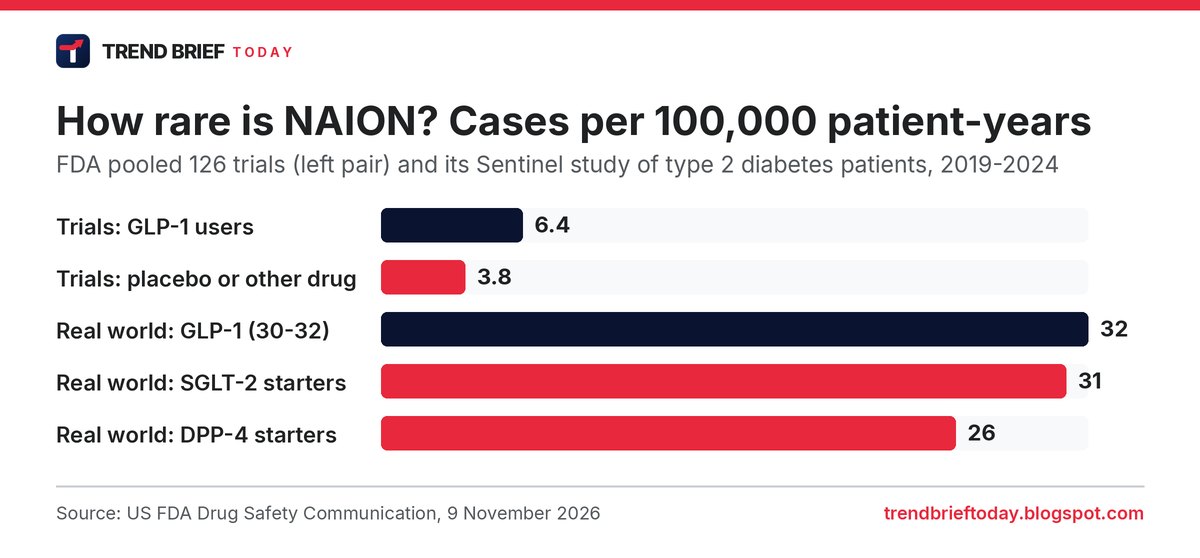
Our reading of those numbers: diabetes itself is doing a lot of the work, as CNBC also points out, and the extra risk tied to the drug class, if it is real, is a few cases per 100,000 people per year.[2] That is why the FDA framed this as a label warning and not as a reason to pull or restrict the drugs. The agency also said its review of animal data did not find a mechanism that would explain how GLP-1 drugs could raise the risk.[1][5]
The 2024 study that started it
The FDA says its review was triggered by a July 2024 paper in JAMA Ophthalmology by Jimena Hathaway and colleagues at Massachusetts Eye and Ear and Harvard.[1][12] The team searched records of 16,827 patients seen by neuro-ophthalmologists at one hospital between December 2017 and November 2023 and compared people prescribed semaglutide with matched patients on other drugs.[7]
| Group in the Hathaway study | NAION cases: semaglutide vs other drugs | Hazard ratio |
|---|---|---|
| Type 2 diabetes (710 patients) | 17 vs 6 | 4.28 |
| Overweight or obesity (979 patients) | 20 vs 3 | 7.64 |
Those hazard ratios look alarming, but the study was small, came from a single specialist eye clinic (where NAION patients are concentrated) and could not show cause and effect, a limit its own authors stated. The FDA said it "identified several limitations of this study" but felt a full review was warranted.[7][1][12] The much larger trial pool the FDA used shows a far smaller gap.
What Novo Nordisk and Eli Lilly said
Novo Nordisk, which makes Ozempic, Rybelsus and Wegovy, said it "continues to believe the data do not establish a cause-and-effect relationship" and that it remains "confident in the benefit-risk profile" of its GLP-1 medicines. It added that it recognises NAION "can have a profound impact on patients and their families".[2][3]
Eli Lilly, maker of Mounjaro, Zepbound and Foundayo, said it is "carefully evaluating the update and will respond to FDA promptly", and pointed out that the FDA notice applies to the whole class and "does not reference any findings specific to Lilly medicines".[2][5]
What patients are being told to do
The FDA advice to patients is short. Know the symptoms. If any of them appear, contact your health care professional right away. If you have already had NAION, talk to your prescriber about whether to keep taking the drug.[1]
The American Academy of Ophthalmology, in a statement to the BBC, put it this way: "Don't stop your medication without talking to your doctor, and if you notice sudden, painless vision loss in one eye, see an ophthalmologist promptly." The academy said "any added risk appears small".[3] The FDA's note for doctors says they should refer suspected cases to an eye specialist quickly and consider stopping the GLP-1 in someone who develops NAION, unless the benefits clearly outweigh the risk.[1][5]
In the UK, the MHRA tells anyone on semaglutide who notices a sudden change in their eyesight in one or both eyes to go urgently to eye casualty, or A&E if there is no eye casualty nearby, and to report it through the Yellow Card scheme.[10][11] In the US, side effects can be reported to the FDA online or on 1-800-332-1088.[1] For other UK health warnings this week, see our page on the UKHSA cold-health alert.
UK, Europe and Canada: where they stand
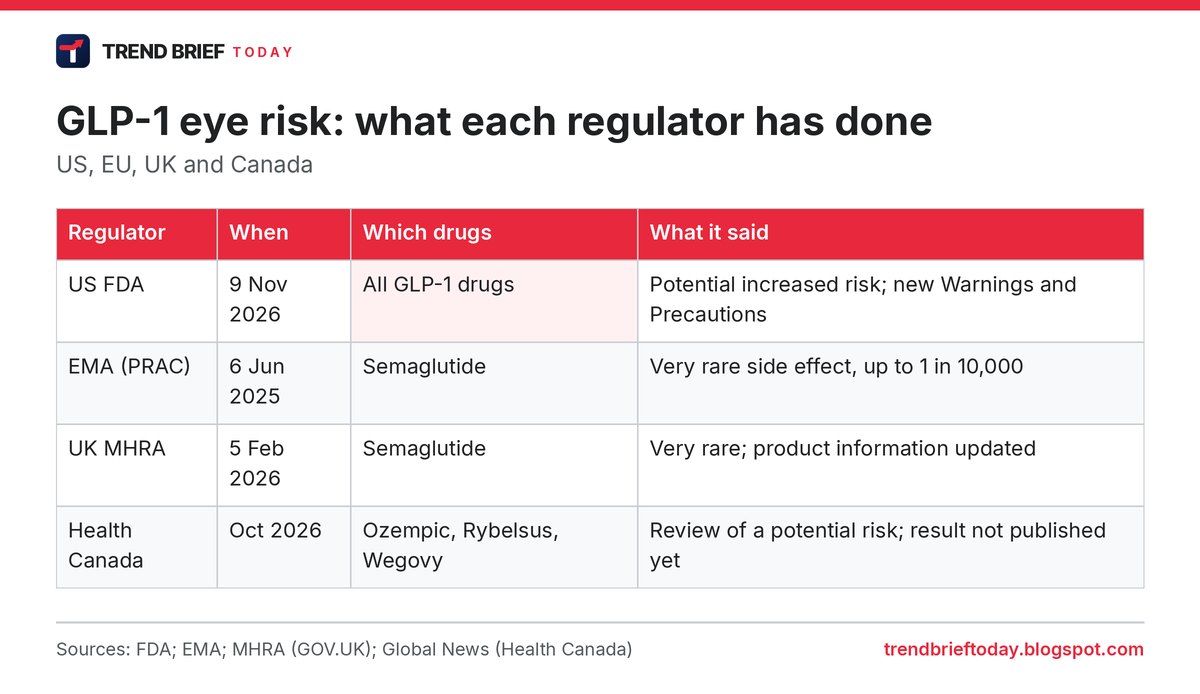
Europe moved first. On 6 June 2025 the European Medicines Agency's safety committee, PRAC, concluded that NAION is a "very rare" side effect of semaglutide, meaning it may affect up to 1 in 10,000 people taking it. PRAC said large studies point to roughly a two-fold higher risk in adults with type 2 diabetes, or about one extra case per 10,000 person-years of treatment, and that semaglutide should be stopped if NAION is confirmed.[8][9]
The UK's MHRA updated the product information for Ozempic, Rybelsus and Wegovy on 5 February 2026, describing NAION as a very rare risk and calling it "extremely small".[10][11] Both the EU and UK actions were about semaglutide. The FDA's step this week is wider, because it covers tirzepatide (Mounjaro, Zepbound) and the rest of the class as well.[1][8]
In Canada, Global News reports that Health Canada said last month it had identified a potential safety risk with Ozempic, Rybelsus and Wegovy related to NAION and is reviewing it. Results had not been published by 11 November.[6]
Timeline
| Date | Event |
|---|---|
| July 2024 | Hathaway study in JAMA Ophthalmology links semaglutide with higher NAION risk at one Boston eye clinic[7] |
| January 2025 | EMA's PRAC opens a review of semaglutide and NAION[9] |
| 6 June 2025 | PRAC: NAION is a very rare side effect of semaglutide (up to 1 in 10,000)[8] |
| 5 February 2026 | MHRA updates UK product information for Ozempic, Rybelsus and Wegovy[10] |
| October 2026 | Health Canada flags a potential NAION risk and opens a review[6] |
| 9 November 2026 | FDA requires a NAION warning on all GLP-1 drugs[1] |
Frequently asked questions
Can Ozempic or Wegovy cause blindness?
The FDA says GLP-1 drugs carry a potential increased risk of NAION, a rare condition that can cause permanent vision loss in one eye. It has not concluded the drugs cause it, and the extra risk in trials was a few cases per 100,000 patient-years.[1][2]
Does the warning cover Mounjaro and Zepbound?
Yes. It applies to every FDA-approved GLP-1 receptor agonist, and tirzepatide (Mounjaro, Zepbound) is on the FDA's list.[1][6]
Should I stop taking my GLP-1 because of this?
Not on your own. Both the FDA and the American Academy of Ophthalmology say to talk to your prescriber, and to seek urgent care if you get sudden vision loss.[1][3]
What does NAION feel like?
Usually nothing painful. People notice sudden dimming, blurring or a missing area of vision in one eye, often on waking, and colours may look dull.[1][10]
Is this warning new in the UK?
No. The MHRA added NAION as a very rare risk for semaglutide in February 2026, after the EMA's June 2025 decision. The FDA's move is the US step and covers more drugs.[10][8]
More explainers: browse every Trend Brief Today page in the all briefs index, or read our UKHSA cold-health alert guide.
References
- "FDA Requires Safety Labeling Changes for Glucagon-Like Peptide-1 Receptor Agonists (GLP-1 RAs) Due to Potential Increased Risk of Rare But Serious Eye Condition". US Food and Drug Administration. November 9, 2026.
- "FDA warns of vision loss risk linked to popular GLP-1 drugs like Wegovy, Zepbound". CNBC. November 10, 2026.
- "Makers of GLP-1 drugs ordered to add warnings about rare eye condition that can lead to blindness". BBC News. November 10, 2026.
- "FDA warns GLP-1 drugs carry potential risk of rare eye condition". STAT. November 9, 2026.
- "FDA Adds NAION Risk Warning to GLP-1 Labeling". Review of Optometry. November 10, 2026.
- "FDA to require vision loss warning on GLP-1 drug labels". Global News. November 10, 2026.
- Hathaway JT, et al. "Risk of Nonarteritic Anterior Ischemic Optic Neuropathy in Patients Prescribed Semaglutide". JAMA Ophthalmology 142(8):732-739. July 2024.
- "PRAC concludes eye condition NAION is a very rare side effect of semaglutide medicines Ozempic, Rybelsus and Wegovy". European Medicines Agency. June 6, 2025.
- "Eye disorder is a 'very rare' side effect of weight-loss drugs, concludes EMA review". The Pharmaceutical Journal. June 9, 2025.
- "MHRA updates guidance for semaglutide prescribers and patients". Medicines and Healthcare products Regulatory Agency (GOV.UK). February 5, 2026.
- "Semaglutide (Wegovy, Ozempic and Rybelsus): risk of non-arteritic anterior ischemic optic neuropathy (NAION)". MHRA Drug Safety Update (GOV.UK). February 5, 2026.
- "Safety Update Required for GLP-1 Receptor Agonists Due to Risk of 'Rare But Serious' Ocular Condition". DocWire News. November 10, 2026.
- "FDA warns of rare eye condition causing blindness from GLP-1 weight loss medications". The Guardian. November 10, 2026.