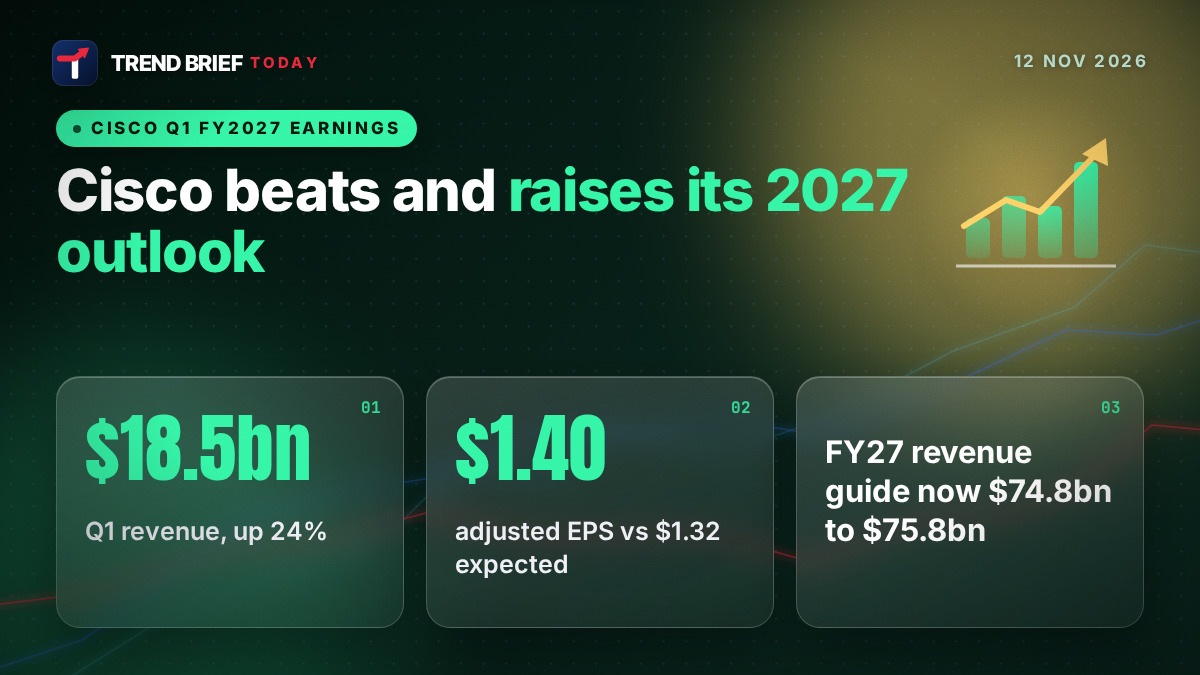
Cisco reported record first-quarter revenue of $18.5 billion on Thursday, November 12, 2026, up 24% from a year earlier, and raised its full-year forecast to $74.8 billion to $75.8 billion. Adjusted earnings came in at $1.40 a share, ahead of the roughly $1.32 Wall Street expected.[1][2][3] The beat came from networking, where sales jumped 43% as cloud giants keep buying switches and routers for AI data centres. The shares closed at $102.01 before the release and jumped as high as $110.63 in after-hours trading, but the gain faded during the evening and the stock was at about $101.75, slightly below the close, by 5:35 p.m. ET.[8][10]
 | |
| Company | Cisco Systems (Nasdaq: CSCO) |
|---|---|
| Reported | Thursday, November 12, 2026, after the close[1][2] |
| Quarter | Q1 fiscal 2027, ended October 24, 2026[1] |
| Revenue | $18.5 billion, up 24% (forecast about $18.11bn)[1][3][4] |
| Adjusted EPS | $1.40, up 40% (forecast about $1.32)[1][3][4] |
| GAAP EPS | $1.14, up 58%[1] |
| FY27 revenue guide | $74.8bn to $75.8bn (was $72.2bn to $73.4bn)[1][5] |
| Dividend | $0.42 a share, paid January 20, 2027[1] |
| Close, Nov 12 | $102.01 (+1.24%); high $110.63 after hours, about $101.75 at 5:35 p.m. ET[8][10] |
| CEO | Chuck Robbins[1] |
What Cisco reported
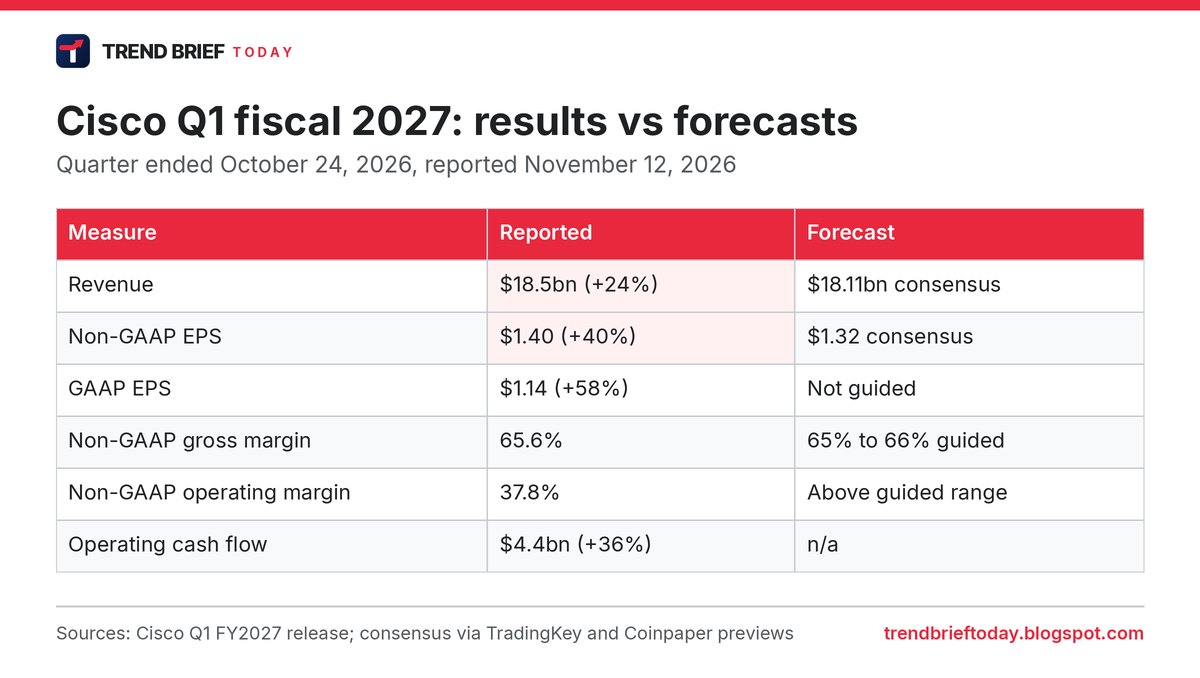
Cisco's fiscal year starts in late July, so the quarter it reported on Thursday ran from late July to October 24, 2026. Revenue was $18.5 billion against $14.9 billion a year earlier, a 24% rise. Product revenue grew 32% and services revenue only 1%.[1][2]
Profit grew much faster than sales. GAAP net income rose 59% to $4.6 billion, or $1.14 a share. On the adjusted (non-GAAP) basis that analysts track, which leaves out items such as stock-based pay and acquisition costs, net income was $5.6 billion, or $1.40 a share, up 40%. Operating cash flow was $4.4 billion, up 36%.[1][2]
Chuck Robbins, Cisco's chair and CEO, said it was "the strongest revenue and non-GAAP earnings per share growth rates for Cisco in over 15 years" and described "a multi-year networking supercycle". Chief financial officer Mark Patterson said revenue, adjusted operating margin and adjusted EPS all came in above the top of the company's own guidance ranges.[1][2]
Did Cisco beat earnings?
Yes, on both lines. Before the report, analysts expected about $18.11 billion in revenue and about $1.32 in adjusted EPS, roughly in the middle of Cisco's own guidance of $18.0 billion to $18.2 billion and $1.32 to $1.34.[3][4] Cisco delivered $18.5 billion and $1.40, so revenue came in about $390 million above the consensus and EPS 8 cents above it. Reuters led with the raised annual forecast and "strong AI networking demand".[9]
The bar was not low. TradingKey noted that EPS estimates had risen about 15% over the previous 90 days and revenue estimates about 8%, so the market was already expecting a strong quarter.[3]
Networking and AI orders drove the quarter
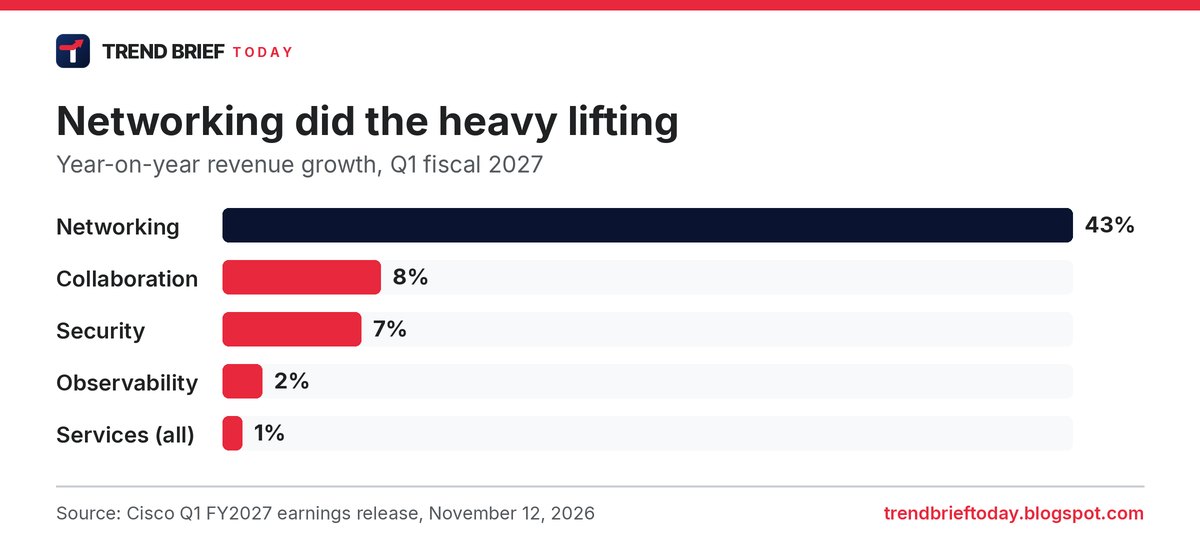
Networking product revenue rose 43%. The other product lines grew far more slowly: collaboration 8%, security 7% and observability (the Splunk-based monitoring business) 2%.[1][2] All three regions grew by double digits, with the Americas up 28%, Europe, Middle East and Africa up 18%, and Asia Pacific, Japan and China up 21%.[1]
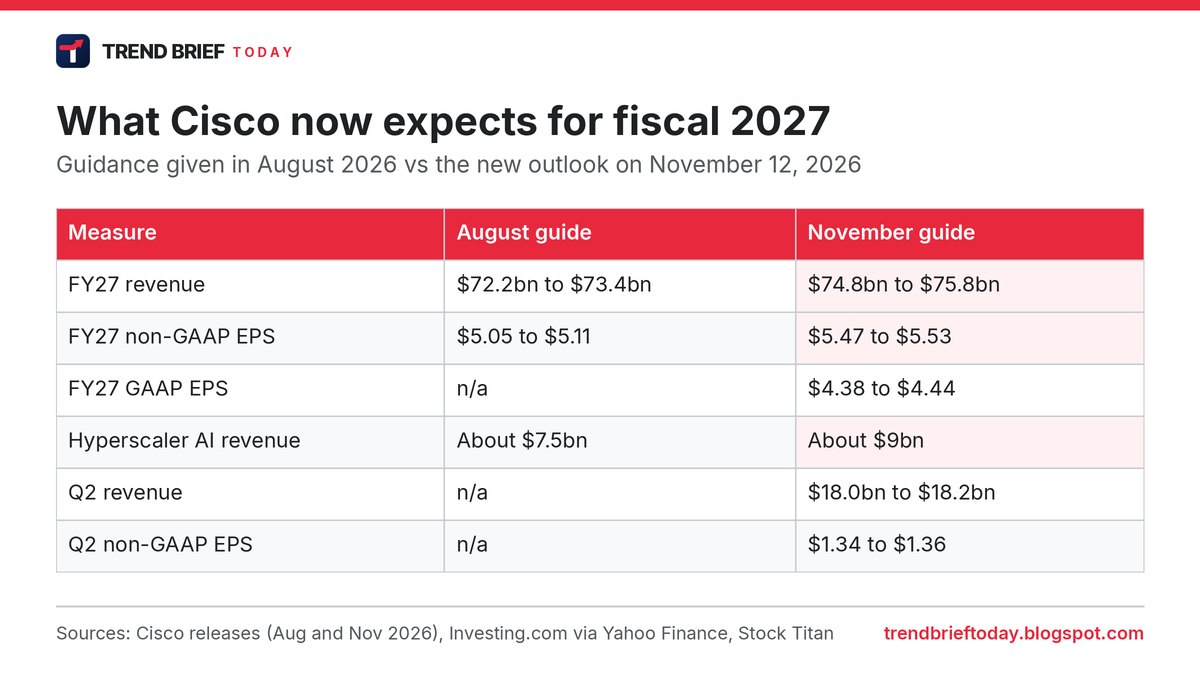
The big change is AI. In fiscal 2026 Cisco took $9.3 billion of AI infrastructure orders from hyperscalers, the largest cloud companies, and said it expected about $7.5 billion of AI infrastructure revenue from them in fiscal 2027.[3][4] Stock Titan reports Cisco has now raised that revenue expectation to $9 billion, which the company says is more than double the fiscal 2026 total, and Cisco's release refers to "the raised expectation of AI infrastructure revenue from hyperscalers".[1][2]
The new fiscal 2027 outlook
In August, Cisco guided fiscal 2027 revenue of $72.2 billion to $73.4 billion and adjusted EPS of $5.05 to $5.11, already above analyst estimates at the time.[5] It now expects revenue of $74.8 billion to $75.8 billion, adjusted EPS of $5.47 to $5.53 and GAAP EPS of $4.38 to $4.44.[1][2] The midpoint of the revenue range moved up by about $2.5 billion and the EPS midpoint by 42 cents, or about 8%.
For the second quarter (November to January), Cisco guided revenue of $18.0 billion to $18.2 billion, adjusted gross margin of 65% to 66%, adjusted operating margin of 36% to 37%, and adjusted EPS of $1.34 to $1.36.[1] That range is below the $18.5 billion just reported, but it is above what analysts expected: CNBC put the LSEG consensus for the quarter at $17.88 billion in revenue and $1.23 in adjusted EPS.[1][11] The step down from the first quarter is something investors will want explained, whether it is caution or the timing of large AI shipments.
The catch: AI hardware squeezes margins
AI networking gear earns less than Cisco's software and services. Adjusted gross margin was 65.6%, down from 68.1% a year earlier, and adjusted product gross margin fell to 63.7% from 67.2%.[1] When Cisco gave its fiscal 2027 outlook in August, Barclays analysts said it "implies lower product gross margin, which we think may be due to AI dilution".[5]
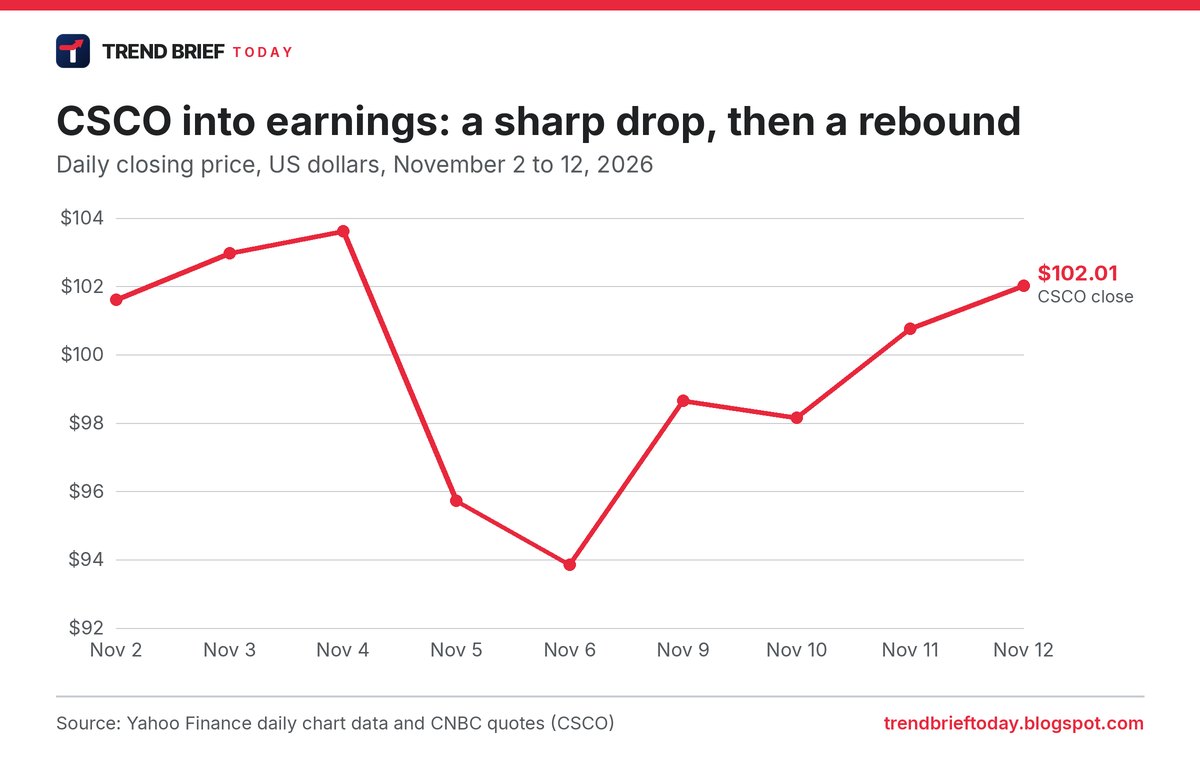
The same worry was behind the stock's slide before this report. On November 5, Morgan Stanley's Meta Marshall cut Cisco to Equal-weight and lowered her price target to $120 from $135. Investor's Business Daily summed up the call as AI hurting gross margins, and the stock fell about 7.6% that day.[3][6][7] Even so, operating margin improved because costs grew slowly: GAAP operating expenses fell 3% and adjusted operating margin was 37.8%.[1][2]
What it means for CSCO stock
Cisco shares closed the regular session at $102.01, up 1.24%, before the 4:05 p.m. ET release. In the first minutes after hours they jumped as high as $110.63, fell back to $101.25, and were near $105 by about 4:30 p.m. ET, up roughly 3%.[2][8] The rise did not hold. During the evening, as the earnings call ran, the shares drifted lower, and by 5:35 p.m. ET they were at about $101.75, down 0.25% from the close.[8][10] After-hours trading is thin, so the real test is Friday's session.
The muted reaction makes some sense. CNBC notes that Cisco shares were up about 35% this year going into the report, against about 9% for the Nasdaq, so a lot of good news was already in the price.[11] In August, too, the stock fell even though the results and outlook beat forecasts.[5]
The stock had a rough month going into the report. It closed at $115.07 on October 13 and fell to $93.85 on November 6, about 18% lower, before bouncing back this week.[3][8] For context, in August the shares dropped more than 9% the day after a strong report because expectations were so high.[5]
Cisco also kept returning cash. It paid $1.7 billion in dividends and spent $2.0 billion buying back about 18 million shares at an average of $112.38, above the current price, leaving $6.1 billion in its buyback programme. The next dividend of $0.42 a share goes to holders of record on January 4, 2027.[1] Cisco's results land in a tense week for AI stocks: Nvidia's CEO Jensen Huang resigned on Thursday, and Nebius shares fell 17% after its own results.
What to watch next
| When | What |
|---|---|
| Nov 12, 4:30 p.m. ET | Earnings call (1:30 p.m. PT); replay until November 18[1] |
| Friday, Nov 13 | First full trading session after the report |
| Within 24 hours | Text of the call's prepared remarks on Cisco's investor site[1] |
| January 4, 2027 | Record date for the $0.42 dividend[1] |
| January 20, 2027 | Dividend paid[1] |
| Not yet dated | Q2 fiscal 2027 results, for the quarter to late January (guide $18.0bn to $18.2bn)[1] |
Frequently asked questions
Did Cisco beat earnings in Q1 fiscal 2027?
Yes. Revenue was $18.5 billion against about $18.11 billion expected, and adjusted EPS was $1.40 against about $1.32.[1][3][4]
Why did Cisco stock rise and then fall after hours?
It first jumped because Cisco beat forecasts and raised its fiscal 2027 revenue and EPS guidance, helped by 43% growth in networking and a higher AI revenue target from hyperscalers.[1][2] The gain faded during the evening, and the stock was about flat with the close by 5:35 p.m. ET. Shares were already up about 35% this year, so expectations were high.[8][10][11]
What is Cisco's fiscal 2027 guidance?
Revenue of $74.8 billion to $75.8 billion and adjusted EPS of $5.47 to $5.53, up from $72.2 billion to $73.4 billion and $5.05 to $5.11.[1][5]
When is Cisco's next dividend?
$0.42 a share, paid January 20, 2027, to holders of record on January 4, 2027.[1]
When does Cisco's fiscal year end?
In late July. Fiscal 2027 runs from late July 2026 to late July 2027, which is why a quarter ending in October is called the first quarter.[1]
References
- "Cisco Reports First Quarter Earnings". Cisco Newsroom. November 12, 2026. newsroom.cisco.com
- "Cisco Q1 Fiscal 2027 Earnings: Revenue Rises 24% to a Record $18.5 Billion". Stock Titan. November 12, 2026. stocktitan.net
- "Cisco Stock Retests $101.60 Ahead of Q1 Results, With AI Orders in Focus". TradingKey. November 12, 2026. tradingkey.com
- "Cisco Earnings Preview: Can AI Data Center Spending Drive Another Revenue Beat?". Coinpaper. November 12, 2026. coinpaper.com
- "Cisco shares fall 9% as solid AI-fueled outlook faces lofty expectations". Investing.com, via Yahoo Finance. August 12, 2026. finance.yahoo.com
- "Morgan Stanley Downgrades Cisco On AI Impacting Gross Margins". Investor's Business Daily. November 5, 2026. investors.com
- "Cisco Falls 7% on Morgan Stanley Downgrade; Ciena Plunges 15%, Arista Networks Tumbles 10%". 24/7 Wall St. November 5, 2026. 247wallst.com
- CSCO closing and after-hours quotes and daily chart data, checked 21:30 GMT November 12, 2026. CNBC and Yahoo Finance. cnbc.com
- "Cisco raises annual revenue forecast on strong AI networking demand". Reuters. November 12, 2026. reuters.com
- CSCO after-hours quotes (CNBC, 5:35 p.m. ET) and Yahoo Finance 5-minute extended-hours chart data, checked 22:35 GMT November 12, 2026. finance.yahoo.com
- "Cisco beats on earnings, says AI infrastructure revenue will double this fiscal year". CNBC. November 12, 2026. cnbc.com