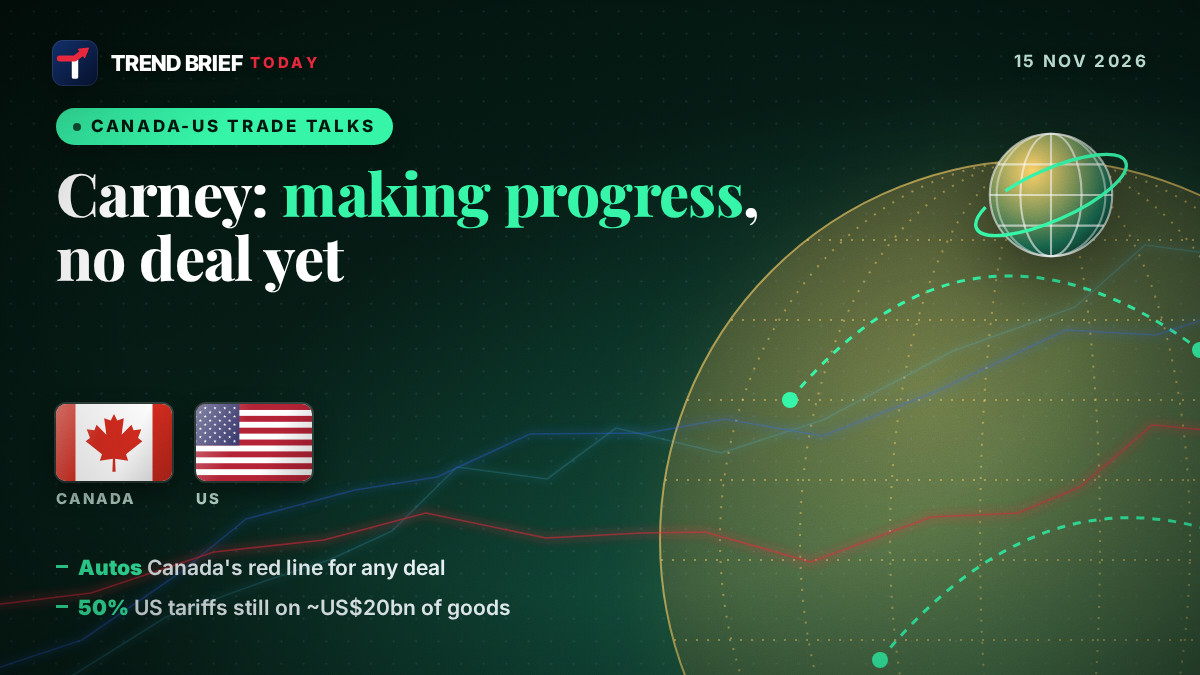
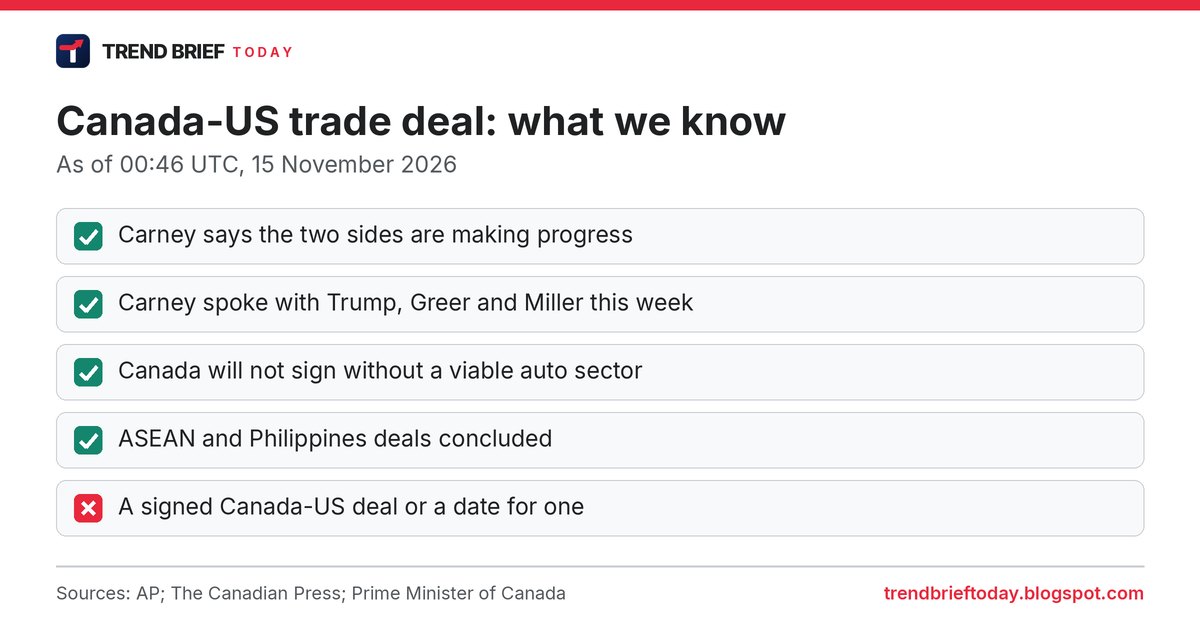
Canadian Prime Minister Mark Carney said on Saturday, November 14, that Canada and the United States are making progress toward a trade deal, three months after talks collapsed in August. "There is the possibility of a deal, a bilateral deal. But we're not yet there," he said in Manila. He also drew a red line: Canada will not sign anything that leaves it without a viable auto industry.[1][2]
 | |
| Latest | Carney: "We are making progress", 14 Nov 2026[1][2] |
|---|---|
| Where | Manila, Philippines, at the ASEAN summit[1][3] |
| On the call | Donald Trump, Jamieson Greer, Stephen Miller[1][2] |
| Canada's red line | A viable Canadian auto sector[1][2] |
| US tariffs | 50% on about US$20 billion of goods since 22 Aug[1][5] |
| Talks collapsed | Friday, 21 August 2026[1][5] |
| New Asia deals | ASEAN (substantially concluded), Philippines (concluded)[1][3][4] |
| Status | No deal, no date |
What did Carney say?
Speaking to reporters in Manila, where he is attending the summit of the Association of Southeast Asian Nations (ASEAN), Carney said he had held "quite a long, substantive conversation with President Trump just before leaving for this trip."[1][2] "We are making progress. There is the possibility of a deal, a bilateral deal. But we're not yet there," he said.[1]
Two senior US officials were also on the call: US Trade Representative Jamieson Greer and Stephen Miller, Trump's new White House chief of staff.[1][2] Carney did not give a timeline for a deal, and we found no statement from the White House on the call as of 00:46 GMT on November 15.
Why are autos the red line?
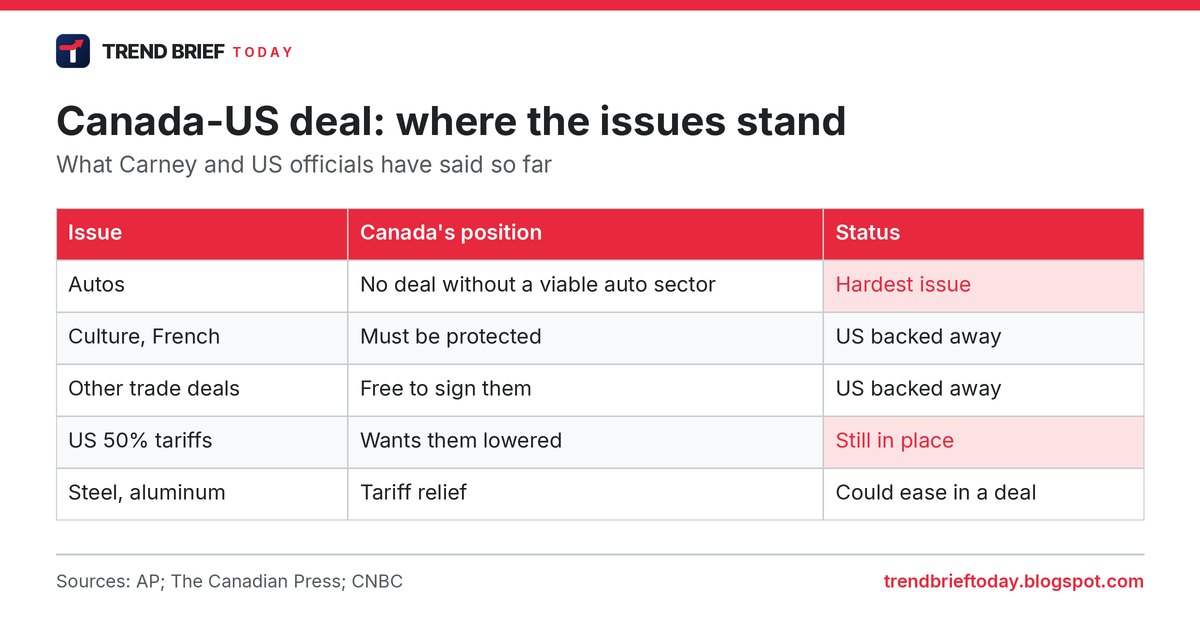
Carney said the auto sector is "one of the fundamental issues in our trade negotiation" and "one of the most challenging issues" in the talks.[2] "Lots of people think that we should just go and take whatever deal," he said. "This government will not settle for a deal with the United States that is not consistent with a viable Canadian auto sector."[2]
He argued that the US car market relies partly on Canadian factories, and that a stable deal on autos would help workers on both sides of the border.[2] Canada's auto industry has been hit hard by Trump's tariffs, AP notes.[1]
Carney also said Chinese investment in Canada's auto sector is limited to a set timeline and number of vehicles, and will be reviewed partly on how well Canada stays integrated with the US industry.[2] And he repeated that Ottawa is "not satisfied in any way" with Stellantis, which is selling its Brampton, Ontario plant after taking federal money.[2] We covered that dispute in Canada threatens to sue Stellantis over the Brampton plant.
Why did the talks collapse in August?
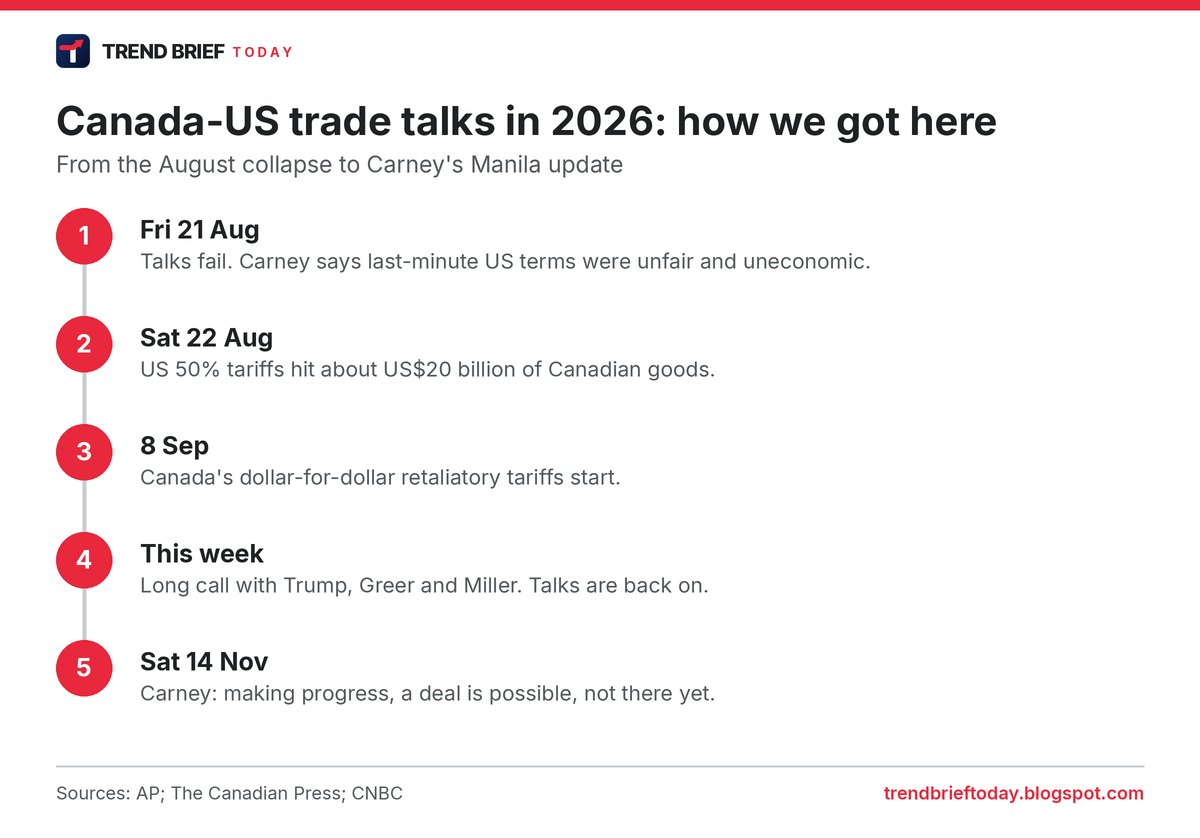
The two sides failed to reach a deal on Friday, August 21. Carney said at the time that "last-minute changes in the U.S. proposed terms were unfair, uneconomic, and called into question the reliability of any deal."[5] Greer said on X that "Canada declined to finalize the trade deal under the terms agreed earlier this week."[5]
On Saturday, August 22, the US put 50% tariffs on about US$20 billion of Canadian goods, including wine, furniture, dairy products, cement, clothing and hockey equipment.[5] "They asked too much and offered too little," Carney said, and Canada's own dollar-for-dollar retaliatory tariffs started on September 8.[1][5] The two countries have since resumed talks.[1]
Before the US midterm elections, Trump said the countries were "very close" to an agreement. Carney said Washington had backed away from demands involving Canada's culture, its French-language protections and its freedom to sign trade deals with other countries.[1]
What changed after the US midterms?
US tariffs on Canadian goods became an issue in the midterm campaign, with Democrats blaming them for higher prices and promising to challenge them.[1] AP describes Canada's position after the Democratic wins as a dilemma: accept a deal that cuts some of Trump's tariffs but leaves others in place, or hold out for free trade while Congress prepares to challenge them.[1]
A deal could reduce tariffs in key sectors, including steel and aluminum, AP reports.[1] In August, Carney said Canada had been willing to drop its remaining retaliatory tariffs on steel, aluminum and autos if the US lowered its own.[5]
What are the new ASEAN and Philippines deals?
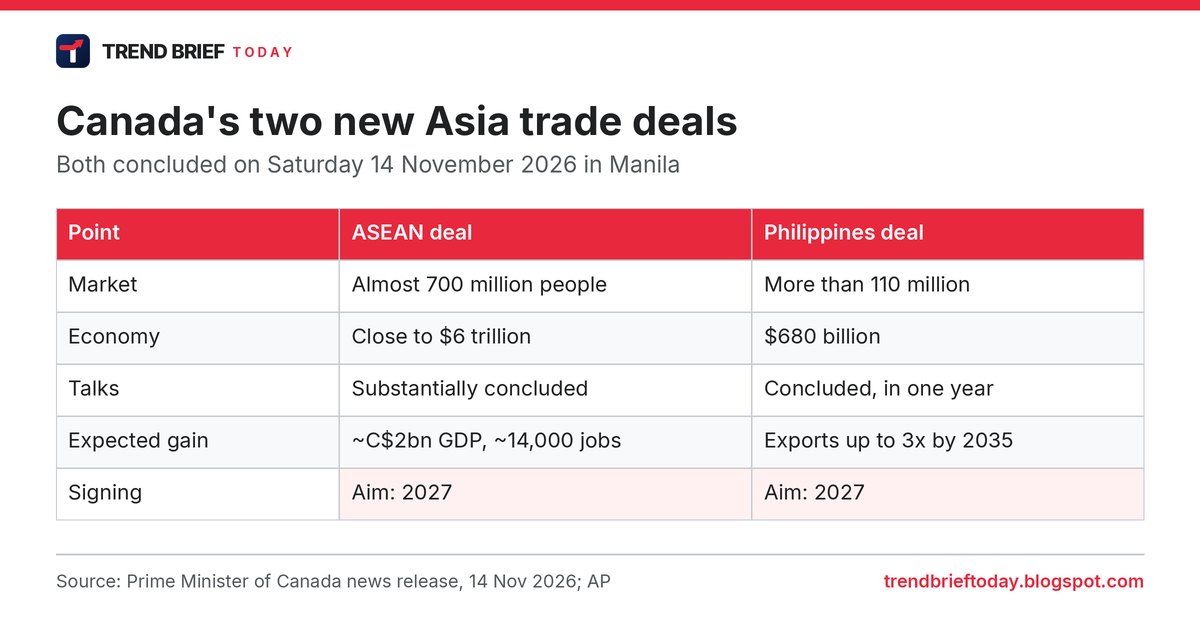
On the same day, Carney announced the "substantial conclusion" of talks on an ASEAN-Canada free trade agreement, covering a bloc of almost 700 million people with an economy of close to $6 trillion.[3][1] Ottawa expects it to add nearly C$2 billion to Canada's GDP and create almost 14,000 jobs, mainly in agriculture and manufacturing, and aims to sign it in 2027.[3][1]
Canada and the Philippines also concluded their own free trade talks, one year after launching them.[3][4] Carney said the Philippines deal covers more than 90% of tariff lines and could help triple Canadian exports to the country by 2035; both sides aim to sign it in 2027.[1][3] "This is good news for Canadians in the agriculture sector, in the aerospace sector, even in AI," Carney told reporters.[4]
Carney has made doubling Canada's exports to countries other than the US by 2035 a central goal, and called the Asia deals part of "reducing our relative reliance on the United States."[1][4]
What happens next?
Carney's trip continues to the Francophonie summit in Cambodia and then to the Asia-Pacific Economic Cooperation (APEC) summit in China, where he is due to meet President Xi Jinping.[1][4] Trump is due in Manila early next week before heading to the APEC summit in Shenzhen, Euronews reports.[4] No Carney-Trump meeting on the trip had been announced as of 00:46 GMT on November 15.
Things to watch:
- Any White House or USTR comment on Carney's account of the call.
- Whether a deal keeps some US tariffs in place, and what it says about autos.[1][2]
- Whether the new US Congress moves to challenge the tariffs on Canada.[1]
Frequently asked questions
Is there a Canada-US trade deal?
Not yet. Carney said on November 14 that the two countries are making progress and a deal is possible, "but we're not yet there."[1]
What is Canada's red line in the talks?
The auto industry. Carney said Canada will not sign a deal that is "not consistent with a viable Canadian auto sector."[2]
Are the US 50% tariffs on Canada still in place?
Yes. They have applied to about US$20 billion of Canadian goods since August 22, and Canada's retaliatory tariffs have applied since September 8.[1][5]
Who was on Carney's call with Trump?
US Trade Representative Jamieson Greer and White House chief of staff Stephen Miller also took part, Carney said.[1][2]
When will the ASEAN and Philippines deals be signed?
Canada is aiming to sign both in 2027.[3][4]
References
- Rob Gillies, Associated Press via ABC News, Canada's Carney reports progress in trade talks with Trump as he expands ties with Asia, 14 November 2026.
- Dylan Robertson, The Canadian Press via Toronto Star, Carney says Canada will only sign a U.S. trade deal that includes viable auto sector, 14 November 2026.
- Prime Minister of Canada, Canada concludes negotiations for two new free trade agreements with the Philippines and ASEAN, news release, 14 November 2026.
- Nathan Rennolds, Euronews, Canada and the Philippines conclude talks on free trade deal, Mark Carney says, 14 November 2026.
- Ian Thomas, CNBC, U.S.-Canada talks fail; Carney says retaliatory tariffs start Sept. 8, 22 August 2026.