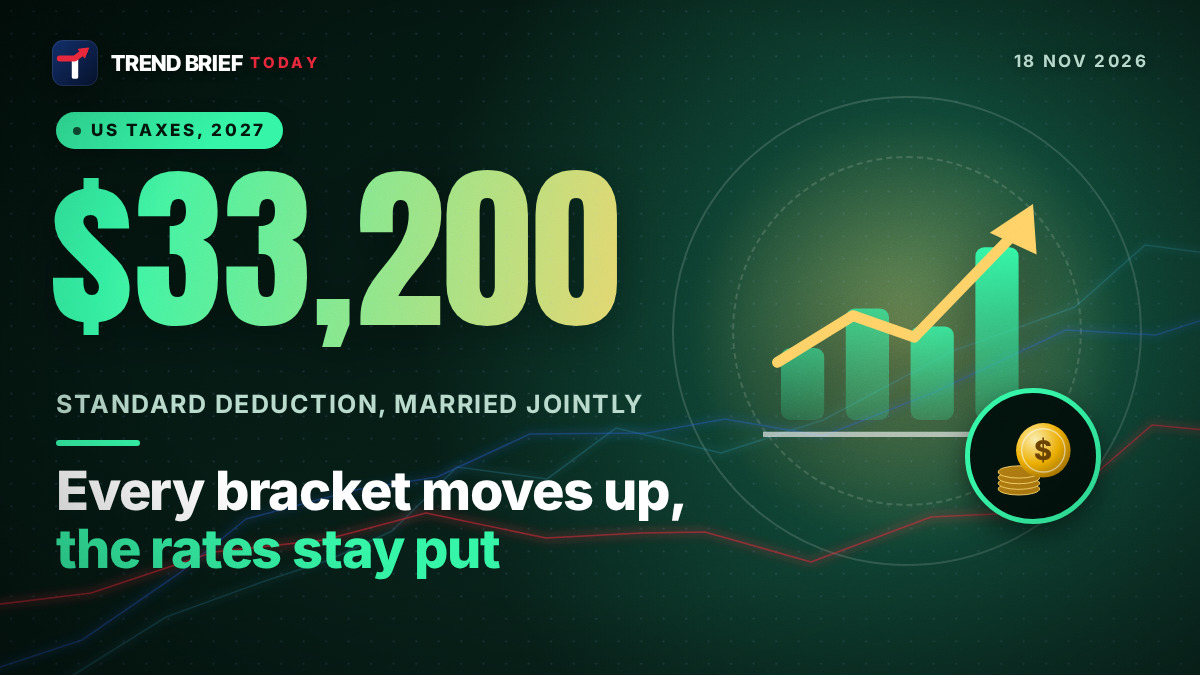
For tax year 2027, the seven federal income tax rates stay at 10%, 12%, 22%, 24%, 32%, 35% and 37%, but every bracket starts at a higher income. A single filer pays 10% on taxable income up to $12,800 and reaches 37% only above $661,375; for married couples filing jointly the top rate starts above $793,650. The standard deduction rises to $16,600 for single filers, $33,200 for married couples filing jointly and $24,925 for heads of household. These numbers apply to income earned in 2027 and the returns you file in early 2028.[1][2][3][4]
 | |
| Tax year | 2027 (returns filed in 2028)[1] |
|---|---|
| Announced | 5 November 2026, IR-2026-133[1] |
| Rates | 10%, 12%, 22%, 24%, 32%, 35%, 37% (unchanged)[1][3] |
| Standard deduction, single | $16,600 (2026: $16,100)[1][5] |
| Standard deduction, married jointly | $33,200 (2026: $32,200)[1][5] |
| Standard deduction, head of household | $24,925 (2026: $24,150)[1][4][5] |
| Top rate starts, single | Over $661,375[1][3] |
| Top rate starts, married jointly | Over $793,650[1][3] |
2027 tax brackets by filing status
The IRS adjusts the brackets every year for inflation so that a pay rise that only keeps up with prices does not push you into a higher rate. For 2027 it changed almost 70 provisions in one go, from the rate tables and the standard deduction to the child tax credit and the estate tax exclusion.[1][3]
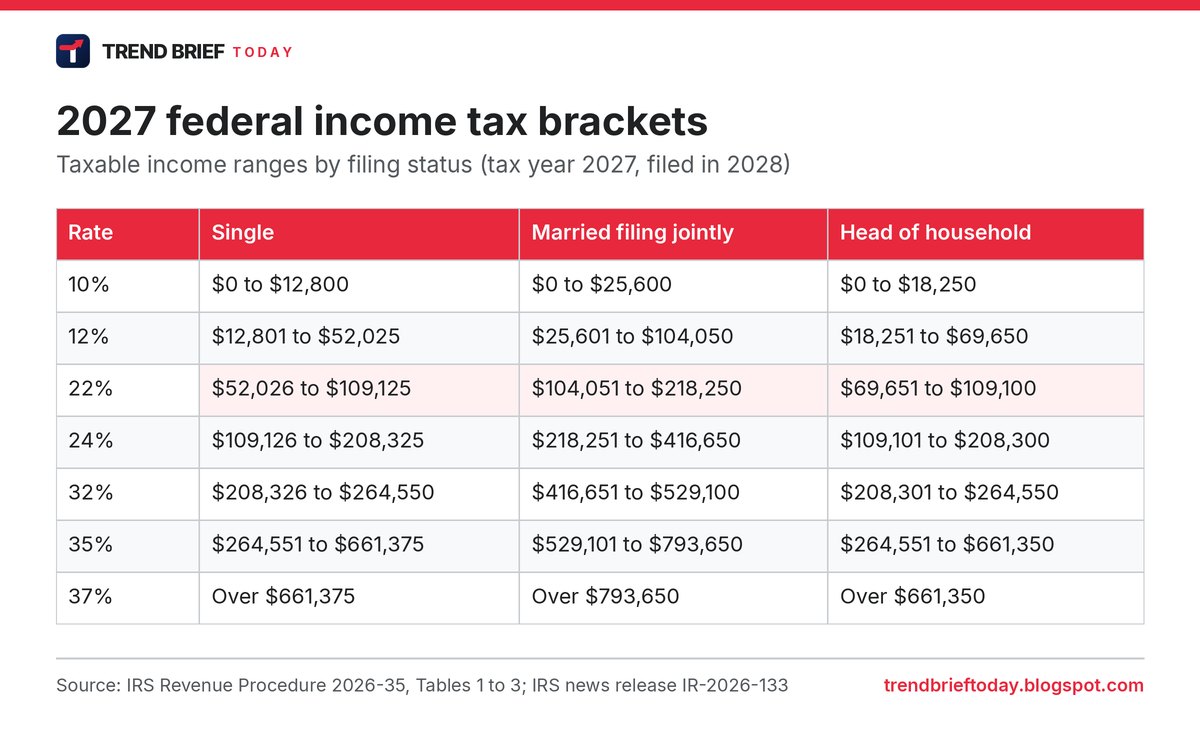
For single filers, the bands are: 10% up to $12,800, 12% up to $52,025, 22% up to $109,125, 24% up to $208,325, 32% up to $264,550, 35% up to $661,375, and 37% above that. Married couples filing jointly get bands that are exactly twice as wide up to the 32% rate: 10% to $25,600, 12% to $104,050, 22% to $218,250, 24% to $416,650, 32% to $529,100, 35% to $793,650, then 37%.[1][2][3]
Heads of household, usually single parents, have their own table: 10% to $18,250, 12% to $69,650, 22% to $109,100, 24% to $208,300, 32% to $264,550, 35% to $661,350, then 37%.[2][4] Married people filing separately use the single bands, except that their 35% band stops at $396,825.[2]
2027 vs 2026: what changed
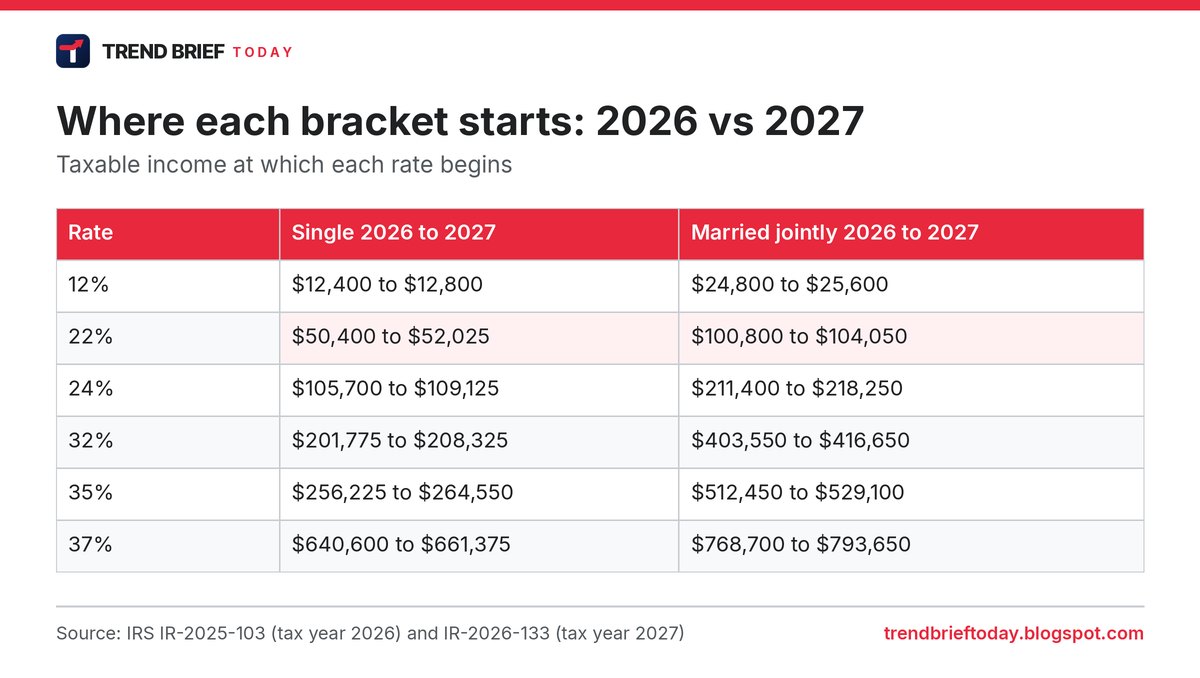
The rates are the same as in 2026. What moved is where each rate begins. In 2026 a single filer hit 22% above $50,400; in 2027 that line moves to $52,025. The 24% line moves from $105,700 to $109,125, and the top rate from $640,600 to $661,375.[1][5][6]
For married couples filing jointly, 22% now starts above $104,050 instead of $100,800, and 37% above $793,650 instead of $768,700.[1][5][6] Most thresholds rose by a little over 3%, in line with the inflation measure the IRS uses.
| Item | 2026 | 2027 |
|---|---|---|
| Standard deduction, single | $16,100 | $16,600[1][5] |
| Standard deduction, married jointly | $32,200 | $33,200[1][5] |
| Standard deduction, head of household | $24,150 | $24,925[1][5] |
| 22% starts above (single) | $50,400 | $52,025[1][5] |
| 37% starts above (single) | $640,600 | $661,375[1][5] |
| 37% starts above (married jointly) | $768,700 | $793,650[1][5] |
| Child tax credit, maximum | $2,200 | $2,300[1] |
| Annual gift exclusion | $19,000 | $20,000[1] |
| Estate tax exclusion | $15,000,000 | $15,480,000[1] |
How much less tax will you pay in 2027?
Not much, and only if your income stays the same. We ran the IRS rate tables for both years on the same gross income, taking the standard deduction and no credits, so the result shows the effect of the new brackets alone.
A single filer on $50,000 pays $3,752 in 2027 against $3,820 in 2026, a saving of $68. At $75,000 or $100,000 the saving is about $281, at $150,000 it is $359, and at $250,000 it is $923. A married couple filing jointly on $150,000 saves $561, and on $400,000 about $718. At $100,000 the couple saves $136.
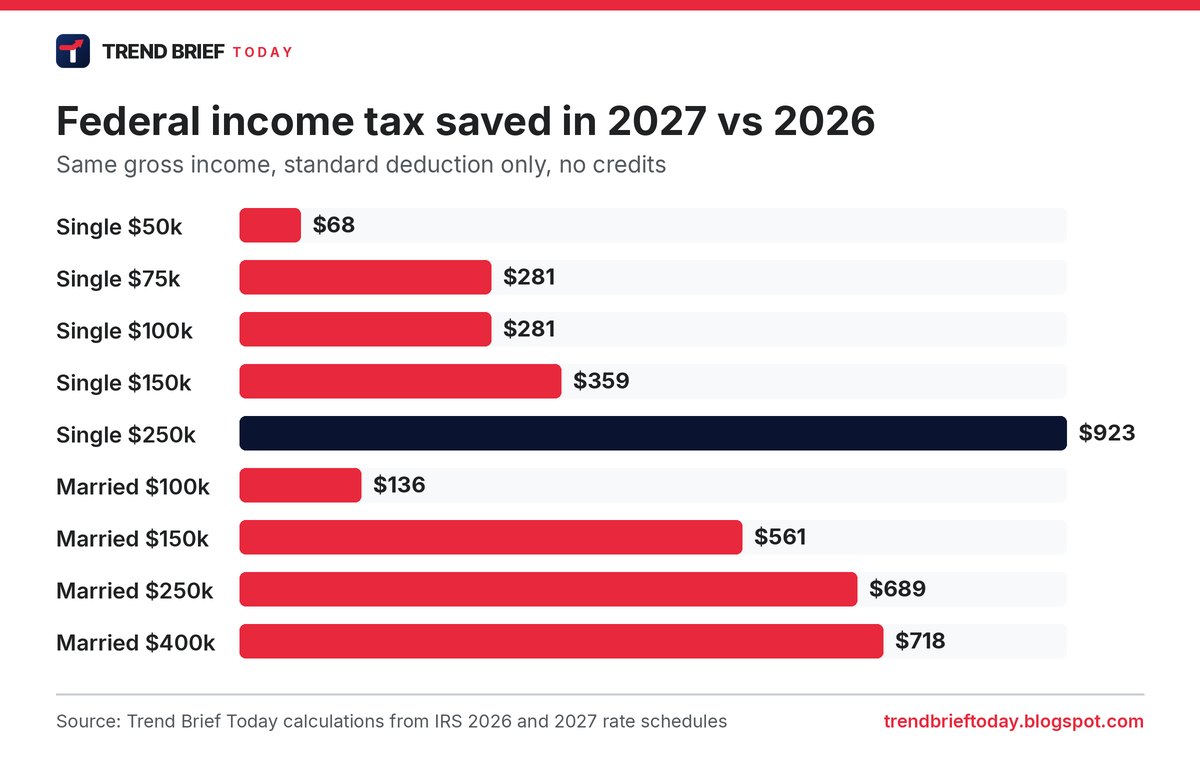
The catch is that inflation adjustments only stop you from going backwards. If your salary rises 3% next year, roughly the same amount as the brackets, your tax bill will rise too, but your rate will not creep up. That is the whole point of the yearly adjustment.
Worked example: single filer on $75,000
Take $75,000 of wages and subtract the 2027 standard deduction of $16,600, which leaves $58,400 of taxable income. The first $12,800 is taxed at 10% ($1,280). The next $39,225, up to $52,025, is taxed at 12% ($4,707). The last $6,375 is taxed at 22% ($1,402.50). The total is $7,389.50, an average rate of about 9.9% on the full $75,000, even though the top rate that applies is 22%.[2]
This is the most common misunderstanding about brackets. Moving into a higher bracket never makes your whole income taxed at the higher rate. Only the dollars above the line pay it.
2027 standard deduction
The standard deduction is $16,600 for single filers and married people filing separately, $33,200 for married couples filing jointly and $24,925 for heads of household.[1][4] If you are 65 or older, or blind, you add an extra $1,700 if you are married or $2,100 if you are unmarried and not a surviving spouse.[2] So a married couple who are both over 65 can deduct $36,600 before any other senior break. Someone who can be claimed as a dependent gets the larger of $1,400 or their earned income plus $500.[2]

When the 2027 brackets apply
These are the brackets for money you earn from 1 January to 31 December 2027. You use them on the return you file in early 2028. The return you file in spring 2027 still uses the 2026 brackets.[1][3] Payroll withholding tables for 2027 will be built on the new numbers, so take-home pay for many workers can rise slightly in January,[3] which is also the month Social Security's 3.6% raise starts for most retirees (see our Social Security payment schedule).
Retirees should also check the 2027 Medicare Part B premium and IRMAA brackets, because IRMAA is based on income from two years earlier and can cost more than the bracket changes save.
Frequently asked questions
What are the 2027 tax brackets for single filers?
10% up to $12,800, 12% to $52,025, 22% to $109,125, 24% to $208,325, 32% to $264,550, 35% to $661,375 and 37% above that.[1][3]
What are the 2027 tax brackets for married filing jointly?
10% up to $25,600, 12% to $104,050, 22% to $218,250, 24% to $416,650, 32% to $529,100, 35% to $793,650 and 37% above that.[1][3]
What is the 2027 standard deduction?
$16,600 single, $33,200 married filing jointly and $24,925 head of household, plus $1,700 or $2,100 extra if you are 65 or older or blind.[1][2][4]
Did the tax rates change for 2027?
No. The seven rates are the same as in 2026. Only the income ranges were raised for inflation.[3]
Are the 2027 brackets used for the tax return I file in 2027?
No. The return you file in 2027 covers 2026 income and uses the 2026 brackets. The 2027 brackets are for the return you file in 2028.[1]
References
- Internal Revenue Service (5 November 2026). "IRS releases tax inflation adjustments for tax year 2027; taxpayers continue to benefit from the Working Families Tax Cuts". IR-2026-133.
- Internal Revenue Service (5 November 2026). "Revenue Procedure 2026-35" (PDF), section 3.01 Tables 1 to 4 and section 3.15.
- Asperin, Alexa Mae (6 November 2026). "2027 tax brackets and standard deduction: Full IRS rates". FOX 11 Los Angeles.
- Avila, Bella (5 November 2026). "IRS Announces 2027 Income Tax Brackets, Updated Standard Deduction". NerdWallet.
- Internal Revenue Service (9 October 2025). "IRS releases tax inflation adjustments for tax year 2026, including amendments from the One, Big, Beautiful Bill". IR-2025-103.
- Stimpson, Jeff (9 October 2025). "Tax brackets, inflation adjustments announced for 2026". Accounting Today.