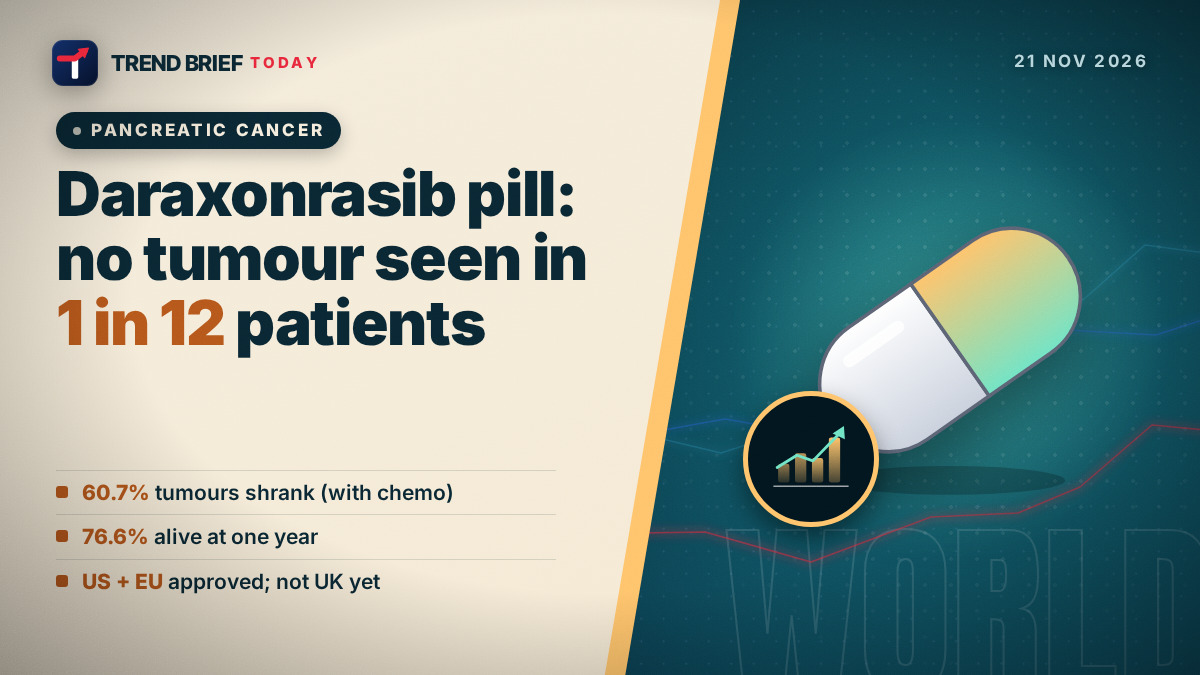
Daraxonrasib, a once-a-day pill sold as Rasonque, left no visible tumour on scans in 8.2% of patients, about 1 in 12, when it was added to standard chemotherapy for pancreatic cancer that had already spread, according to trial results presented in Barcelona on 20 November 2026.[1][4] Tumours shrank in 60.7% of the 61 patients and an estimated 76.6% were alive a year after starting treatment.[1][2] The drug is already approved in the US and the EU for patients whose cancer has grown after earlier treatment, but not in the UK, Canada or Australia, and not yet as a first treatment anywhere.[1][4]
 | |
| Brand name | Rasonque[1][2] |
|---|---|
| Maker | Revolution Medicines (Nasdaq: RVMD)[1] |
| Type | Oral pill, once a day; RAS(ON) inhibitor[1][3] |
| Treats | Metastatic pancreatic adenocarcinoma[1][7] |
| US approval | August 2026, after prior treatment[3][6][9] |
| EU approval | November 2026, after prior treatment[7][8] |
| UK, Canada, Australia | Not approved[1][4] |
| New result | 8.2% complete response with chemo (61 patients)[1][2] |
What the new trial found
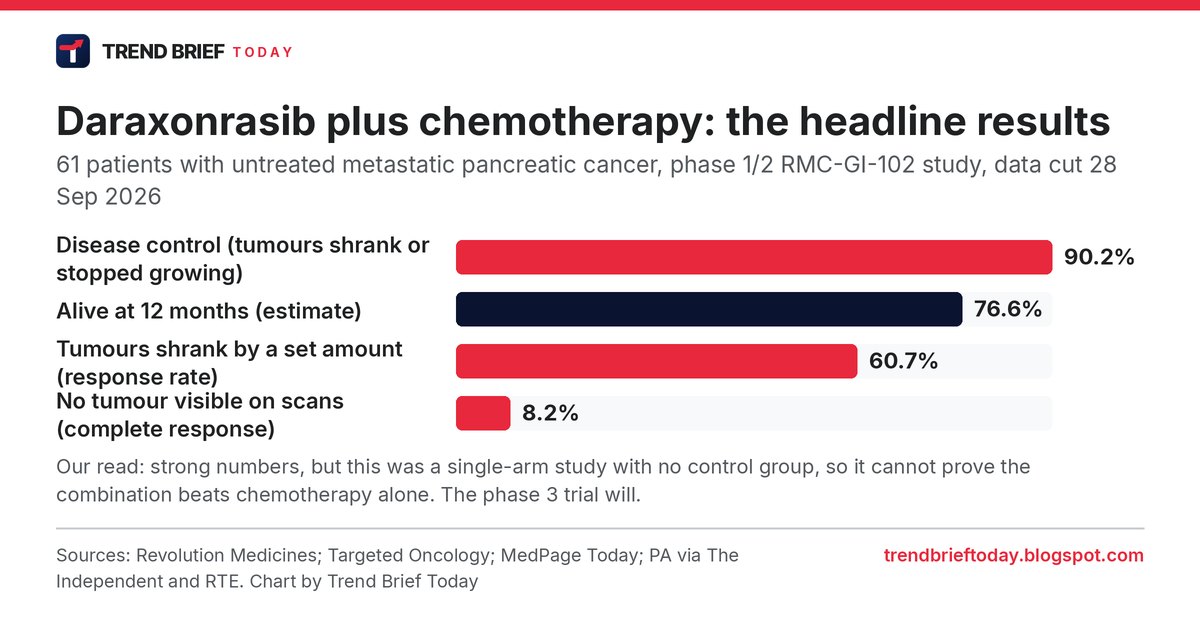
The results come from the first-line group of a phase 1/2 study called RMC-GI-102. Sixty-one people whose pancreatic cancer had spread, and who had not yet had treatment for it, took 200 mg of daraxonrasib every day together with two standard chemotherapy drugs, gemcitabine and nab-paclitaxel.[1][3] Data were counted up to 28 September 2026, with a median follow-up of 18.3 months.[1][2]
Tumours shrank by a meaningful amount in 60.7% of patients and the cancer was held in check in 90.2%.[1][2] In 8.2% the tumours could no longer be seen on CT scans.[4][11] On average it took 12.8 months for the cancer to start growing again, and responses lasted a median of 11.1 months.[1][3] The estimated one-year survival was 76.6%.[1][2]
For comparison, PA reports that around 40% to 45% of patients are alive after a year on chemotherapy alone.[4][5] Dr Wungki Park of Memorial Sloan Kettering Cancer Center, who presented the data, said in a press release quoted by MedPage Today that the result already outpaces the historical 8.5 to 11.1 months of overall survival seen with standard chemotherapy.[3] BioSpace cites analysts at Truist giving a similar historical range of 8.5 to 11 months.[6]
"This is the closest to cure," Park told PA when asked about the patients whose tumours vanished, while saying longer-term survival data would follow.[4][5] He also called the results "a massive, massive breakthrough".[4][11]
Why doctors say be careful with the word cure
This was a small study with no comparison group. Every patient got the combination, so the trial cannot show by itself that adding the pill beats chemotherapy alone.[3][11] Shivan Sivakumar of the University of Birmingham told the Science Media Centre the findings should be read "carefully" for that reason.[3]
Pancreatic Cancer UK's head of research, Dr Madina Kara, called it "a small, initial study" with encouraging results.[4][5] Cancer Research UK's chief executive, Michelle Mitchell, described it as "the biggest leap forward we've seen in decades" but said more trials are needed before the treatment can be assessed for use on the NHS.[4][5]
The answer will come from a much larger phase 3 trial, RASolute 303, which compares the pill alone, the pill plus chemotherapy, and chemotherapy alone in newly diagnosed patients.[1][2] The trial registry lists a target of about 900 patients and an estimated primary completion date of April 2028.[12] BioSpace reports analysts expect a readout around 2028.[6]
How it works
RAS proteins act like a growth switch inside cells. When the KRAS gene is mutated, the switch gets stuck in the on position and keeps telling cancer cells to grow. That mutation is found in more than nine in ten pancreatic tumours.[4][11]
For decades RAS was seen as close to impossible to target with a drug. Daraxonrasib binds to the active, switched-on form of several RAS variants at once, which is why the company calls it a RAS(ON) multi-selective inhibitor.[1][3] It is taken by mouth, not by drip.[1][4]
The earlier trial that got it approved
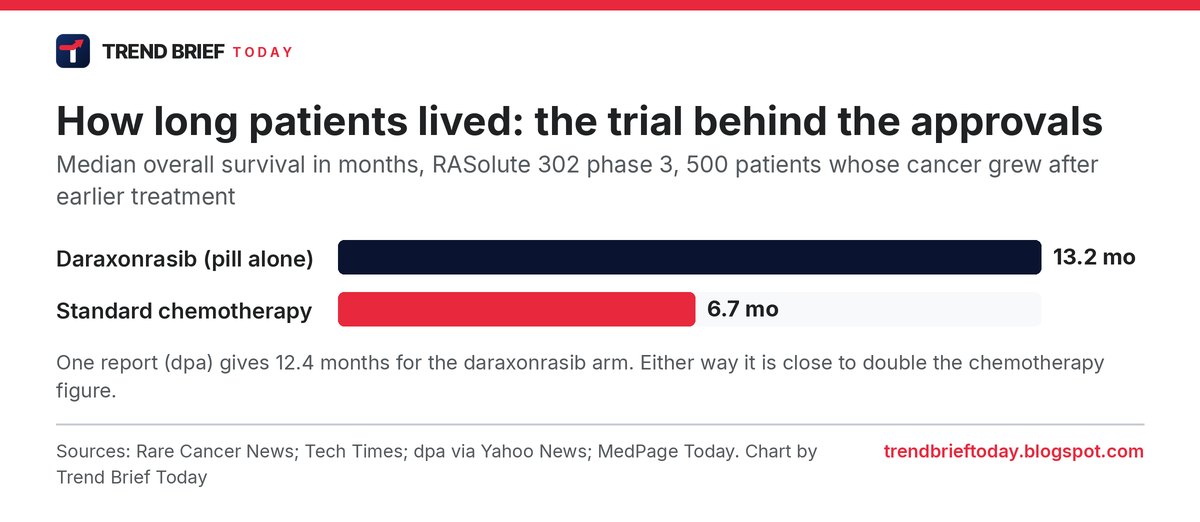
The approvals rest on a different study. RASolute 302 was a randomised phase 3 trial of 500 people whose metastatic pancreatic cancer had grown after earlier treatment. Median overall survival was 13.2 months on daraxonrasib against 6.7 months on chemotherapy, close to double.[7][9] A dpa report on the EU approval gives 12.4 months for the daraxonrasib arm, so we show both figures; the 6.7 months for chemotherapy is the same in every source.[8]
Those results made headlines in May.[4][5] The US Food and Drug Administration approved the pill in late August 2026 for adults with metastatic pancreatic cancer who have had at least one earlier treatment, or who cannot have multi-drug chemotherapy.[3][9][1] The European Commission followed in November for patients who have had at least one earlier treatment.[7][8]
In September 2026 the FDA also gave the pill-plus-chemotherapy combination Breakthrough Therapy Designation for first-line use, a status meant to speed development. It is not an approval.[2][1]
Is daraxonrasib available in the UK, Canada and Australia?
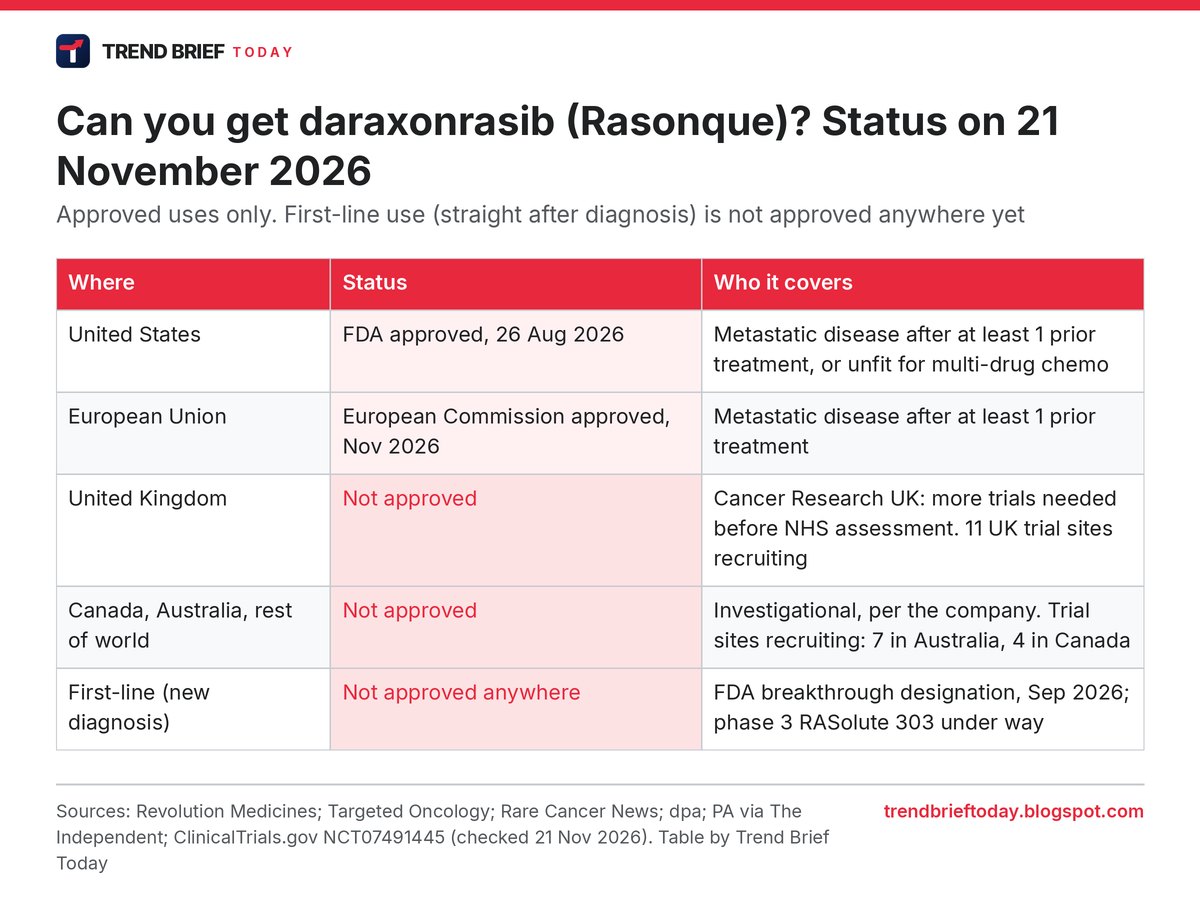
Not as an approved medicine. Revolution Medicines says that outside the US and the EU, Rasonque is still an investigational drug that no regulator has approved.[1] In the UK, Cancer Research UK says more trials are needed before the NHS can assess it.[4][5]
The realistic route for many patients outside the US is a clinical trial. We checked the RASolute 303 entry on ClinicalTrials.gov on 21 November: it lists 106 sites. All 21 US sites are marked as no longer recruiting, while 85 sites in 20 other countries are recruiting, including 11 in the UK (London, Manchester, Birmingham, Cambridge, Liverpool and Torquay), 7 in Australia and 4 in Canada.[12] That fits what Park told PA: the US part of the trial is full but some sites in Europe may still have space.[4][5]
Only a patient's oncologist can say whether they qualify. The trial is for people with untreated metastatic disease.[12][1]
Side effects
The pill has real side effects. In the US prescribing information, rash or other skin problems affected 86% of pancreatic cancer patients on daraxonrasib, diarrhoea 63% and mouth sores 57%, mostly at lower grades.[1][9] Rare but serious risks include a hole in the gut and lung inflammation; each caused one death in trials.[1]
With chemotherapy added, side effects are heavier. In the earlier AACR analysis of the combination, 73% of patients had a grade 3 or worse treatment-related side effect, and anaemia of grade 3 or worse hit 33%.[2] MedPage Today's report of the Barcelona data gives 75% and 33%.[3] Few patients stopped because of side effects: 5% stopped the pill for drug-related side effects in MedPage Today's report, and PA says fewer than 5% stopped treatment.[3][4]
Sales and what it means for Revolution Medicines
Rasonque made about $198 million in its first five weeks on the US market, far above Wall Street's estimates, and more than 5,000 patients had received it by the time of the company's third-quarter call.[10][9] Revolution Medicines is listed on the Nasdaq.[1]
Timeline
| Date | Event |
|---|---|
| 9 Mar 2026 | Phase 3 RASolute 303 (first-line) starts[12] |
| Apr 2026 | First results of the pill plus chemo at the AACR meeting[1][2] |
| May 2026 | RASolute 302 survival results make headlines[4][5] |
| Aug 2026 | FDA approves Rasonque after prior treatment[3][9] |
| Sep 2026 | FDA Breakthrough Therapy Designation for pill plus chemo, first line[2][1] |
| Nov 2026 | European Commission approval[7][8] |
| 20 Nov 2026 | Updated first-line data presented at ENA in Barcelona[1][2] |
| Apr 2028 (est.) | RASolute 303 primary completion[12] |
What is confirmed and what is not
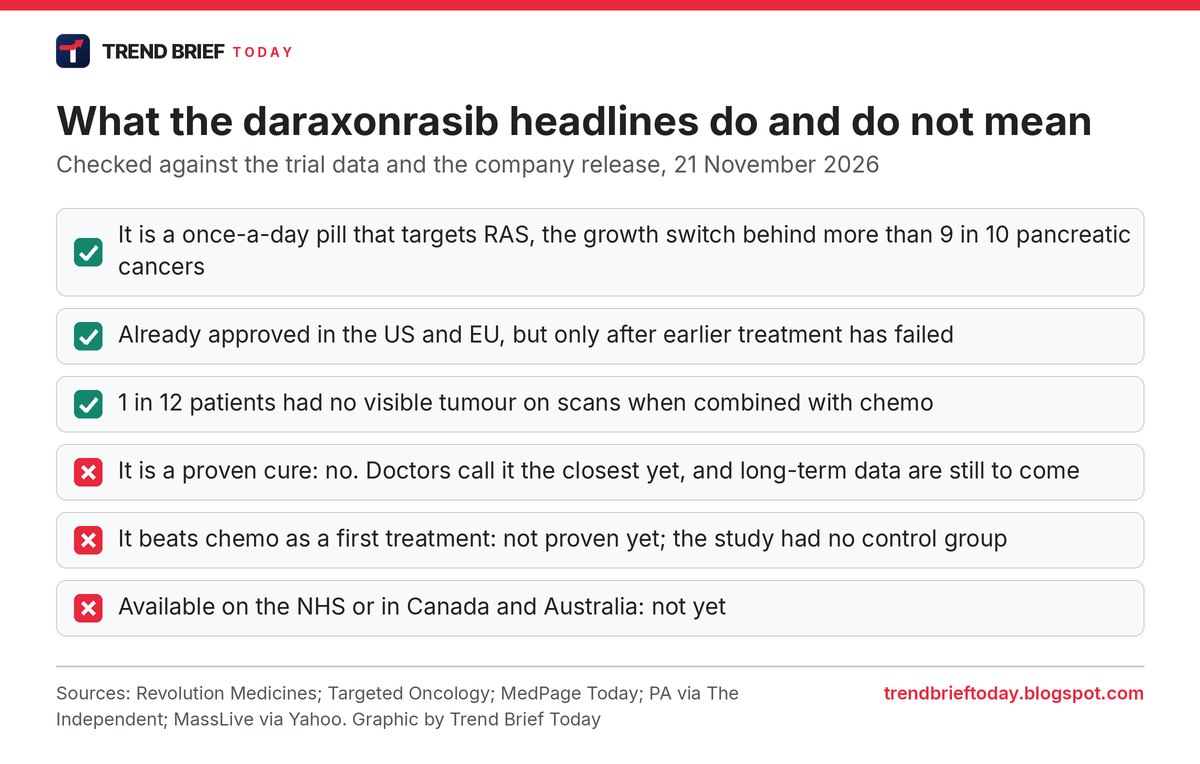
| Claim | Status |
|---|---|
| Approved in the US and EU for previously treated metastatic pancreatic cancer | Confirmed[1][7] |
| Roughly doubled median survival against chemotherapy in a randomised trial | Confirmed[7][9] |
| Tumours not visible on scans in 1 in 12 patients with chemo | Confirmed, small single-arm study[1][4] |
| A cure for pancreatic cancer | Not shown; long-term data still to come[4][11] |
| Better than chemotherapy as a first treatment | Not proven until RASolute 303 reports[3][1] |
| Available on the NHS | No[4][5] |
Frequently asked questions
What is daraxonrasib?
A once-daily pill, sold as Rasonque, that blocks the RAS growth signal driving most pancreatic cancers. It is made by Revolution Medicines.[1][4]
Is daraxonrasib a cure for pancreatic cancer?
No one can say that yet. The lead researcher called it "the closest to cure" for patients whose tumours vanished, but the study was small, had no control group, and long-term survival is still being measured.[4][3]
Is daraxonrasib approved by the FDA?
Yes, since August 2026, for adults with metastatic pancreatic cancer who have had at least one prior treatment or cannot have multi-drug chemotherapy. First-line use is not approved.[3][1]
Can I get daraxonrasib on the NHS?
Not yet. It has no UK approval, and Cancer Research UK says more trials are needed before the NHS can assess it.[1][4] UK patients may ask their oncologist about the RASolute 303 trial, which has recruiting sites in the UK.[12]
What are the side effects?
Mostly rash and other skin problems, diarrhoea and mouth sores, with rare serious gut and lung problems.[1][9]
When will we know if it works as a first treatment?
The phase 3 RASolute 303 trial has an estimated primary completion date of April 2028.[12][6]
References
- Revolution Medicines (GlobeNewswire via Yahoo Finance), Revolution Medicines Presents Updated Phase 1/2 Data for RASONQUE (daraxonrasib) Plus Chemotherapy in First-Line Metastatic Pancreatic Cancer at ENA 2026, 19 November 2026.
- Targeted Oncology, Jonah Feldman, Daraxonrasib Plus Chemo Yields Durable Response in First-Line PDAC, 20 November 2026.
- MedPage Today (via MSN), 'Grand slam' pancreatic cancer drug shows promise as first-line treatment, 20 November 2026.
- The Independent (PA), New pancreatic cancer drug hailed as 'closest thing to a cure', 20 November 2026.
- RTÉ News (PA), Pill for advanced pancreatic cancer shows promise, 20 November 2026.
- BioSpace, Annalee Armstrong, RevMed pads Rasonque's first-line survival advantage in pancreatic cancer with early data, 20 November 2026.
- Rare Cancer News, Oral med now approved in EU for already-treated pancreatic cancer, 18 November 2026.
- dpa (via Yahoo News), EU approves new drug for pancreatic cancer, 17 November 2026.
- Tech Times, The Drug That Ended 30 Years of "Undruggable": Rasonque Posts $197.6 Million in Its First Five Weeks, 5 November 2026.
- BioSpace, RevMed's Rasonque shatters analyst estimates with $198M quarter, 5 November 2026.
- MassLive (via Yahoo News), New pancreatic cancer treatment makes tumors disappear for some patients, 20 November 2026.
- ClinicalTrials.gov, NCT07491445: Study of Daraxonrasib and Daraxonrasib + GnP as First-line Treatment in Patients With Metastatic Pancreatic Adenocarcinoma (RASolute 303), record updated 16 November 2026, checked 21 November 2026.