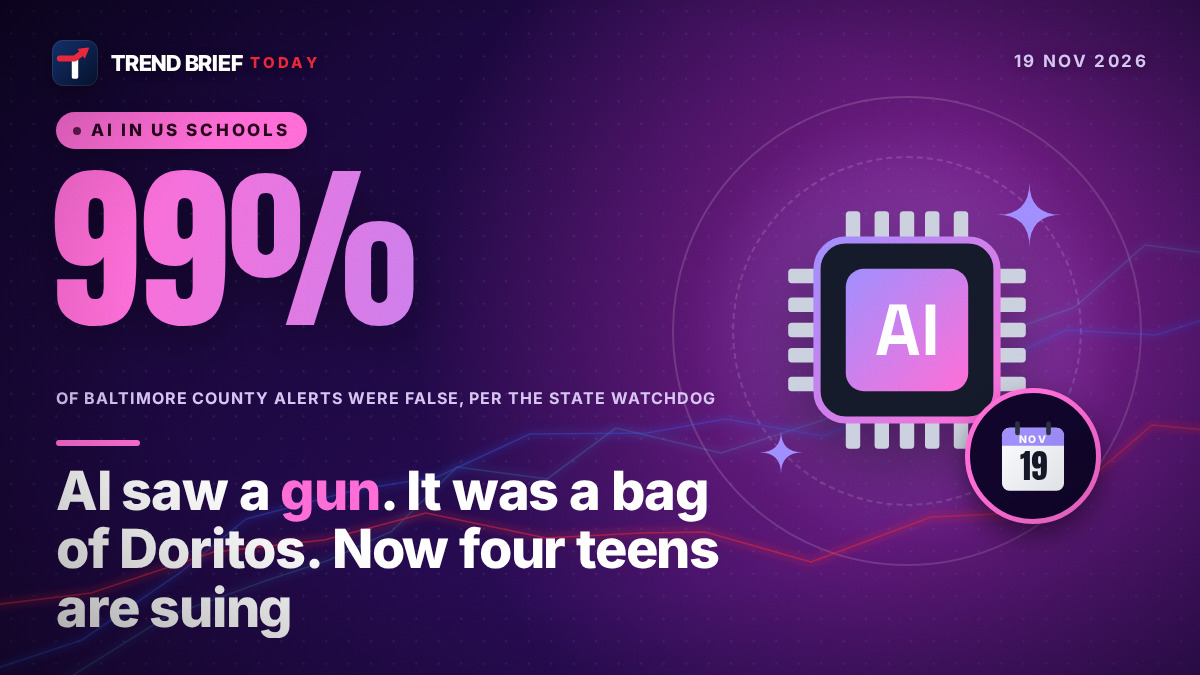
Four Black teenagers from Kenwood High School in Baltimore County, Maryland, sued their school district, county police and the AI company Omnilert on November 17, 2026, more than a year after camera software flagged a bag of Doritos as a gun and officers held them at gunpoint.[1][4] The alert had already been cancelled by school safety staff when police arrived.[1][2] Maryland's education watchdog has found that more than 99% of the system's alerts in county schools were false positives that needed no police response.[5][7] Here is what happened minute by minute, why AI gun detectors throw so many false alarms, and what the lawsuit is asking a judge to do.
 | |
| Incident | October 20, 2025, Kenwood High School, Baltimore County, Maryland[1] |
|---|---|
| System | Omnilert Gun Detect, AI software on school cameras, in county schools since 2023[3] |
| Object flagged | A bag of Cool Ranch Doritos[3] |
| Plaintiffs | Taki Allen, Yui-Osa Ogbeide, Devon Thompson Jr., Keith Winfield III[1] |
| Defendants | Omnilert, Baltimore County Police Department, Board of Education, school and police officials[2][6] |
| Filed | November 17, 2026, Baltimore County Circuit Court, 31-page complaint[1] |
| Claims | Unreasonable search and seizure, false arrest, false imprisonment, negligence[4][6] |
| Asks for | Unspecified damages and a ban on Omnilert until training and protocols improve[3][4] |
What happened at Kenwood High?
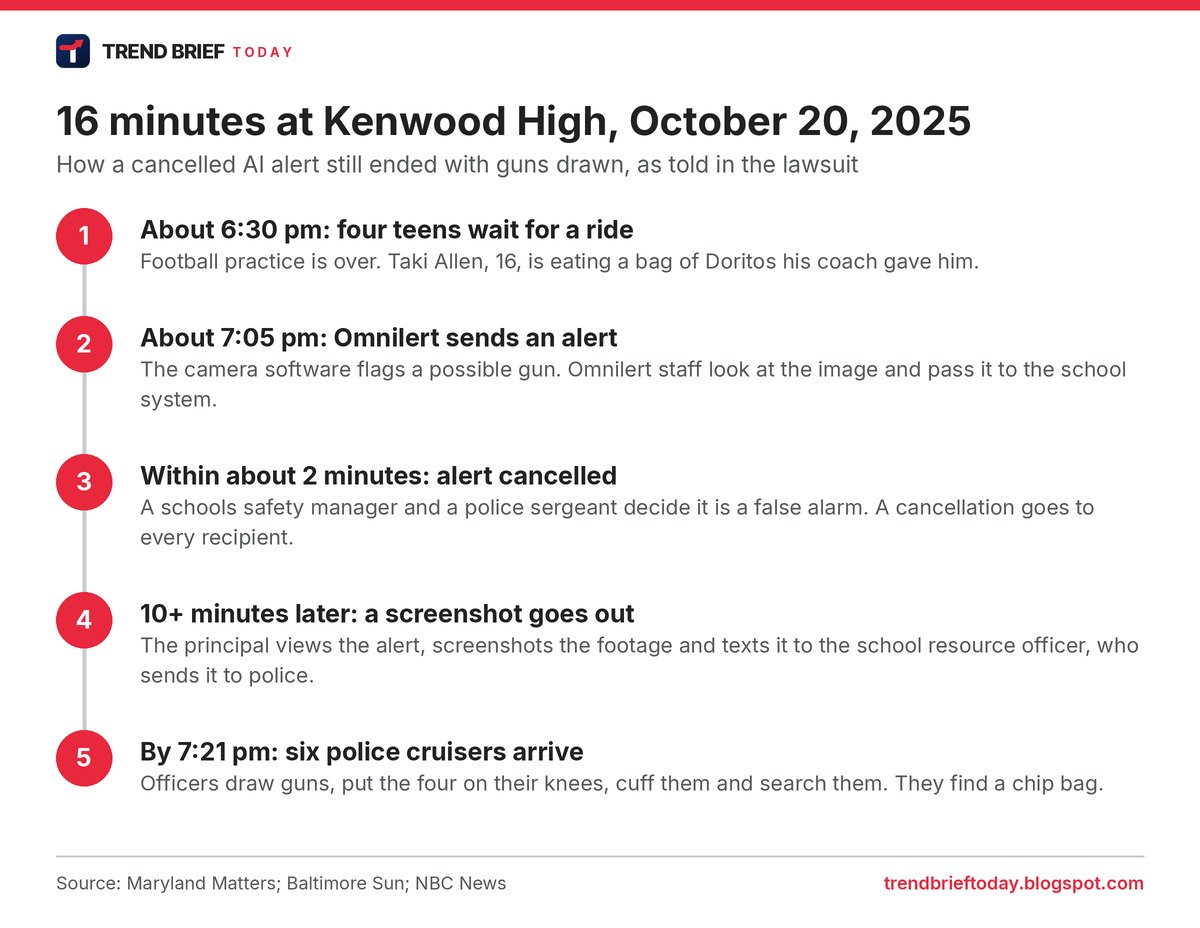
It was a Monday evening in October 2025, about 6:30 pm. Four boys were standing outside Kenwood High School waiting for a ride home after football practice. Taki Allen, who was 16, had a bag of Doritos his coach had handed him after practice.[1] When he finished, he put the empty bag in his pocket.[3]
Around 7:05 pm, the school's Omnilert system sent out an alert. Omnilert's own monitoring staff looked at the image, decided it "closely resembled a gun being held" and passed it on to the school system's safety team "within seconds," according to what a company spokesperson said last year.[3] So far, the process worked the way it is meant to. A schools safety manager, Eric Knox, and a county police sergeant reviewed the alert and decided within about two minutes that it was a false alarm. A cancellation went out to everyone on the alert.[2]
Then the chain broke. According to the complaint, the principal, Catherine Smith, opened the alert more than ten minutes after it had been cancelled, took a screenshot of the video and texted it to the school resource officer. He forwarded it to the police department.[1][2] By 7:21 pm, six police cruisers had surrounded the teenagers. Officers got out, many with guns drawn, ordered the four to their knees, handcuffed them and searched them.[1][2] Allen later said he was bent over the hood of a police car.[3] All anyone found was the chip bag.
Two lines from the complaint have been quoted in nearly every report since. After the search, one officer reportedly told the students "AI is not the best," and another muttered about "stupid AI cameras." And as they left, Corporal Michael Foehrkolb allegedly said, "Hey, thanks for not running away, that would have been a real problem."[1][3] Allen's mother, Frieda Winfield, told WBAL that her advice to her son about staying calm around police "saved their lives in my opinion."[5]
The complaint also includes the text the principal sent to staff afterwards: "No worries. SRO had patrol car roll through. It was a bag of chips," followed by four crying-laughing emojis.[1] The Baltimore Sun reports another exchange in which the resource officer wrote "bag of chips not a gun" and the principal replied starting with "Bwahahaha."[2] The students' lawyers say there has been no public apology, and that Smith is still at the school.[1]
What does the lawsuit claim?
The case was filed by the Lawyers' Committee for Civil Rights Under Law along with local attorney Lon Engel.[7][2] It runs to 31 pages and accuses the defendants of unreasonable search and seizure, false arrest, false imprisonment and negligence. Engel has also mentioned products liability, which is the part aimed squarely at Omnilert.[4][5]
The students want two things. One is money, an unspecified amount, for what they went through. The other is arguably more important for every other student in the county: they are asking the court to stop Baltimore County Public Schools from using Omnilert until the district improves its training and its protocols.[3][4]
The complaint makes a pointed argument about the officers' own words. If police at the scene already thought the system was unreliable, it says, they still "relied on the Alert to initiate this painful encounter."[1] It also notes that Omnilert's weapon detection was patented in 2022, "barely a year before it was deployed" in Baltimore County, which was one of its first big rollouts.[1][7]
Freya Jamison of the Lawyers' Committee put the case's theme in one sentence: "We simply can't outsource human judgment to machines, and this case shows exactly why."[1]
What do Omnilert and the school system say?
Very little, for now. Omnilert told Maryland Matters it "cannot comment on lawsuits."[1] But its vice president of marketing, Blake Mitchell, went further with the Baltimore Sun and the Banner: "What these four students went through on October 20, 2025 should not have happened, and we are truly sorry for the fear they and their families experienced."[2][3] He said the system is built to send anything that could be a firearm to trained people, to avoid the "worst possible outcome" of missing a real gun.[2]
That is close to what the company and the district said in 2025. Back then the superintendent, Myriam Rodgers, said the program "did what it was supposed to do," which was to raise an alert so humans could check it.[4] Baltimore County police and the school system declined to comment on the lawsuit.[2][6]
What did Maryland's inspector general find?
Maryland's Office of the Inspector General for Education looked into the incident in November 2025. Three findings matter here.
- It was not the bag. The report says the system "did not detect a single blue potato chip bag as a threat." The alert came from the student's hand movement, "including its position and angle," and an unidentified object in his hand.[6][2] Inspector General Richard Henry later told WBAL radio it was evening and low light, the bag was by the student's hip, and his fingers were partly tucked in.[1]
- No racial bias was found in how the system flagged the student.[6][3]
- The principal may simply have missed the cancellation. She viewed the alert by zooming into the video, which the report says could have made her overlook the cancellation text.[2]
The lawsuit cites one more figure from the inspector general that is hard to ignore: more than 99% of Omnilert alerts in Baltimore County schools were false positives that did not need a police response.[5][7] Henry has described Kenwood as "human error" and says the system works.[1] Both things can be true at once. And that is the real problem.
Why do AI gun detectors produce so many false alarms?
A 99% false alert rate sounds like a broken product. It is actually what you should expect from almost any detector that hunts for something rare, and it is worth seeing why with simple numbers.
Imagine a school district's cameras see one million people over some stretch of time, and 10 of them really are carrying a gun. Now give the AI accuracy figures that are generous: it catches 95% of real guns and wrongly flags only 0.1% of innocent people. Those are our assumptions, not Omnilert's published numbers, which the company does not release in this form.
- Real guns flagged: 95% of 10 = 9.5 alerts.
- Innocent people flagged: 0.1% of 999,990 = about 1,000 alerts.
- Share of alerts that are real: 9.5 out of about 1,009.5 = under 1%.
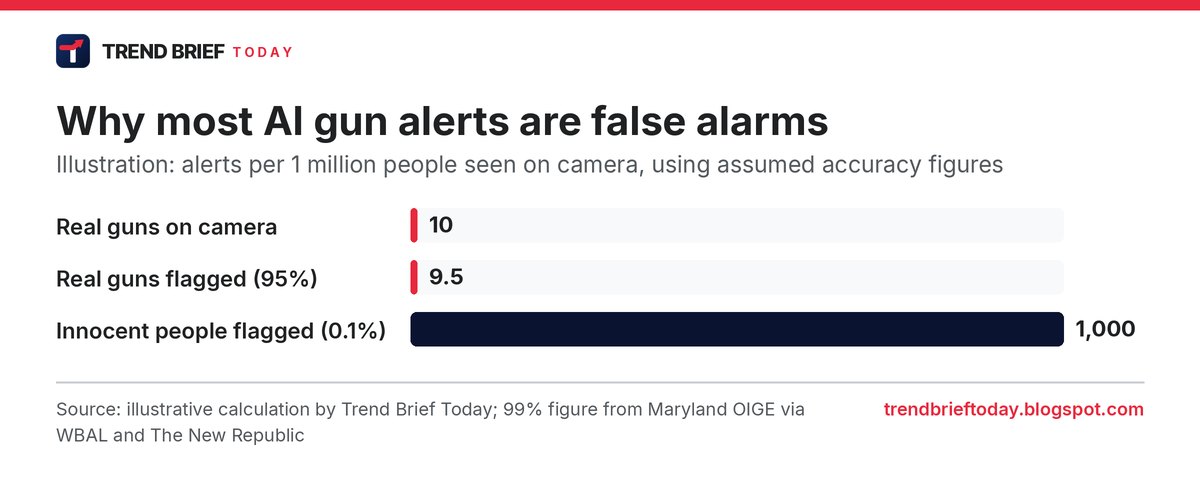
So a system that is right about innocent people 99.9% of the time still produces roughly 105 false alarms for every real one. That lines up with the inspector general's "more than 99%" almost exactly. Statisticians call this the base rate problem. Medical screening tests for rare diseases run into it too, which is why a positive screen usually leads to a second test rather than straight to surgery.
That is the honest way to read the Maryland figure. A 99% false alarm share does not mean the AI is "1% accurate." It means the AI is only a first filter, and everything depends on the human check that comes next. At Kenwood, the human check worked in about two minutes.[2] What failed was the step after that: a cancelled alert got a second life through a screenshot and a text message.
A little more arithmetic shows why the human step is so fragile. If each false alarm takes a trained reviewer about two minutes to clear, as it did at Kenwood, then 1,000 false alerts cost about 33 hours of review time. Spread that across a big district and dozens of staff on an alert list, and somebody, sooner or later, will read an old alert without seeing that it was cancelled.
Can AI gun detection miss a real gun?
Yes, and Omnilert is being sued for that too. In January 2025 a student opened fire in the cafeteria at Antioch High School in Nashville. Two students died, including the shooter, and another was wounded. Nashville's school district had approved a contract worth more than $1 million in 2023 to add Omnilert's AI layer to its cameras, but the system did not detect the gun.[8][1]
A district spokesperson said afterwards that the shooter's position meant the imagery "wasn't close enough to get an accurate read and to activate that alarm."[8] The injured survivor sued Omnilert and its reseller in Davidson County in May 2026, arguing the company knew or should have known about limits such as "camera placement, proximity of the weapon to camera sensors, camera angle, lighting, and weapon visibility."[8] Omnilert's co-founder declined to answer Ars Technica's questions about that case.[8]
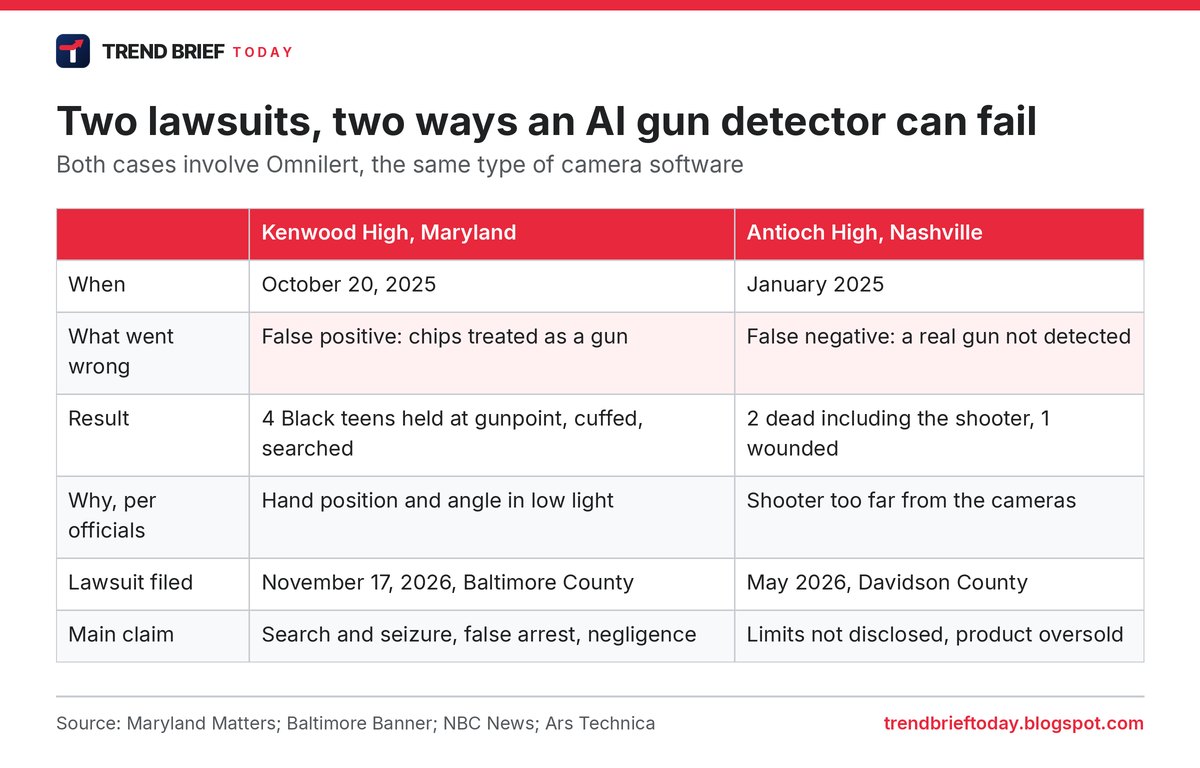
Put the two cases side by side and you can see the trade-off every buyer faces. Tune the software to be more sensitive and you get more Kenwoods: more teenagers holding snacks, phones or umbrellas who get flagged. Tune it to be stricter and you risk more Antiochs, where a real weapon slips through because the camera was too far away or the light was poor. No setting removes both kinds of mistake. The only thing a school can really control is what happens after the alert.
What this means for parents and schools
AI weapon detection is spreading through US schools, usually sold as a layer on top of cameras a district already owns. That is cheaper than metal detectors and less visible, which is part of the appeal. Kenwood shows where the risk actually sits: in the handoff between software, school staff and armed police.
If your child's school uses a system like this, a few direct questions will tell you a lot. Who reviews an alert, and how fast? Does a cancellation reach every person who saw the original alert, including the school resource officer? Can staff forward alert images outside the official process? How many alerts did the system raise last year, and how many turned out to be real? A school that cannot answer the last one does not know how its own system performs.
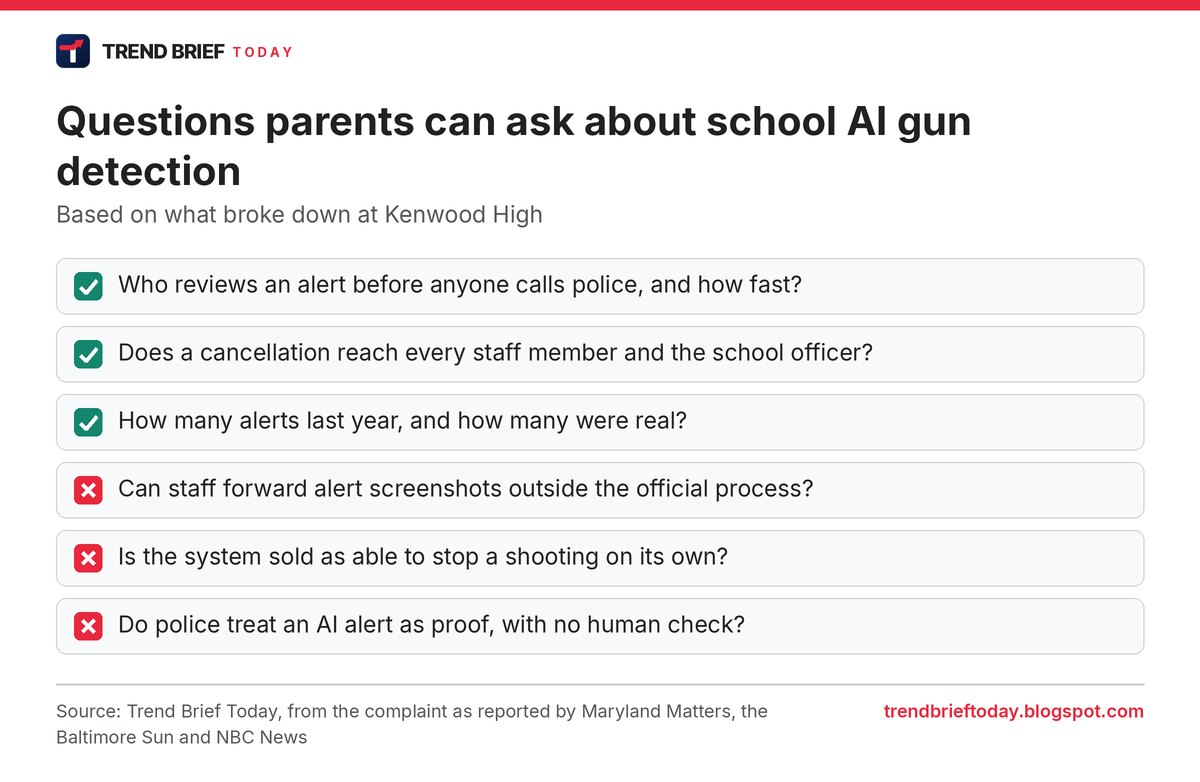
For the four boys at Kenwood, the court case will decide whether anyone pays for that evening. Three of them have graduated and gone to college, and Allen is still at the school, where the same system is still running.[1] Whether the court orders a pause on Omnilert while the case goes on is the next thing to watch. We have written before about how AI tools are being pushed into classrooms in our piece on Google's AI search for schools, and about another fight over who answers for AI mistakes in California's lawsuit against OpenAI.
Timeline
| Date | Event | Source |
|---|---|---|
| 2022 | Omnilert's AI weapon detection is patented, according to the complaint | [1] |
| 2023 | Baltimore County schools install Omnilert; Nashville approves a contract worth over $1 million | [3][8] |
| January 2025 | Antioch High shooting in Nashville; the system does not detect the gun | [8] |
| October 20, 2025 | Kenwood High alert at about 7:05 pm, cancelled within about 2 minutes; police arrive by 7:21 pm | [1][2] |
| November 2025 | Maryland inspector general finds no racial bias, says hand movement triggered the alert | [6] |
| May 2026 | Antioch survivor sues Omnilert and its reseller | [8] |
| November 17, 2026 | Four Kenwood students file suit in Baltimore County Circuit Court | [1][4] |
Frequently asked questions
What AI system mistook the Doritos bag for a gun?
Omnilert Gun Detect, AI software that scans school security camera footage for firearms. Baltimore County Public Schools has used it since 2023.[3][7]
Was the student holding a gun?
No. Taki Allen was holding a bag of Cool Ranch Doritos. Officers found nothing else when they searched the four teens.[3][2]
Did the AI actually see the chip bag as a gun?
Maryland's inspector general says no. The alert was triggered by the student's hand position and angle and an unidentified object in his hand, in low evening light.[6][1]
Who is being sued?
Omnilert, the Baltimore County Police Department, the Baltimore County Board of Education, and several school and police officials, including the principal and individual officers.[2][7]
How often are AI gun alerts wrong?
In Baltimore County schools, more than 99% of alerts were false positives that did not need police, according to the state inspector general as cited in the lawsuit.[5][7] Our illustration above shows why rare events make that share hard to avoid.
Is Baltimore County still using Omnilert?
Yes, as of the lawsuit's filing. The students are asking the court to stop its use until training and protocols improve.[3][1]
References
- William J. Ford, "Baltimore County schools, police sued for AI software 'bag of chips' mistake", Maryland Matters, November 18, 2026.
- Christopher Scarglato and Jessica Baugh, "Kenwood students sue after AI gun alert mistakes Doritos bag for weapon", Baltimore Sun (via MSN), November 18, 2026.
- Kristen Griffith, "Students sue Baltimore County schools after AI weapons detection mistook chips for gun", The Baltimore Banner, November 18, 2026.
- "Baltimore County students sue over AI system that mistook Doritos bag for gun", CBS News Baltimore, November 18, 2026.
- David Collins, "Kenwood High students filed lawsuit after chips bag triggered armed police response", WBAL-TV 11, November 18, 2026.
- Minyvonne Burke, "Teens say AI surveillance system at Baltimore school mistook Doritos bag for a gun", NBC News, November 18, 2026.
- Sophie Jager, "Cops Detained Teens at Gunpoint After AI Misidentified Bag of Chips", The New Republic, November 18, 2026.
- Ars Staff, "School shooting survivor sues AI gun detection firm after system failed to spot weapon", Ars Technica, June 5, 2026.